Start-up breaks temperature barrier in directional drilling, a challenge pursued for years
STEVE KRASE, Hephae Energy Technology
Beneath our feet lies an energy resource capable of supplying the world’s electricity demand many times over. Yet this vast renewable resource remains largely untapped, as accessing deeper and hotter formations requires drilling technologies capable of operating at temperatures reaching beyond today’s limits.
For over a century, geothermal development has largely focused on naturally occurring hydrothermal reservoirs, in regions where heat naturally rises close to the surface, often accompanied by pockets of steam or hot water. These favorable conditions are typically confined to areas with high tectonic or volcanic activity, such as Iceland’s volcanic fields or northern California’s iconic Geysers complex. While these projects clearly demonstrate the value of geothermal energy, they represent only a fraction of the resource’s full potential.
To unlock that potential, the industry must begin thinking in gigawatts, not megawatts. This emerging frontier, known as superhot rock geothermal, represents a step change in scale. Rather than producing tens of megawatts from a field, future projects could deliver gigawatts of clean, firm power. The physics are simple in that the deeper and hotter the rock, the more power we can generate. According to Clean Air Task Force (CATF), “Just 1% of the world’s superhot rock geothermal potential could generate 63 terawatts of clean firm power, eight times more energy than the rest of the world’s electricity put together.” Superhot rock geothermal represents a missing pillar in the global energy portfolio, offering carbon-free power nearly anywhere.
Super-hot rock geothermal has the potential to strengthen energy independence for countries across the globe. Unlike energy resources that depend on imported fuels or geographically concentrated reserves, heat is distributed widely beneath the earth’s surface. By tapping into heat that exists virtually everywhere, nations can generate baseload power from domestic resources, reducing reliance on volatile global energy markets. As drilling technologies advance to access deeper and hotter formations, geothermal offers a pathway for countries to secure long-term, locally produced energy while strengthening grid stability and economic resilience.
STEP CHANGE IN TECHNOLOGY
Similar to geothermal power, directional drilling has been around for over a century and has laid a strong foundation for geothermal development, but critical engineering challenges remain. Unlocking superhot rock resources requires bridging a fundamental technology gap, requiring drilling technologies capable of operating in extreme downhole environments. Directional drilling tools are essential for drilling precise wells, yet their electronics and mechanical systems degrade rapidly at elevated temperatures.
Despite significant investment from the world’s largest oilfield service companies, progress beyond the 200°C threshold has largely stalled over the past 25 years. Today, most commercial directional drilling tools are rated between 150°C and 175°C. A small number of specialized tools reach approximately 200°C, primarily designed for high-temperature gas reservoirs. But even these tools struggle to operate reliably in the extreme thermal environments required for next-generation geothermal development, as their electronics and mechanical systems degrade rapidly at elevated temperatures.
As a result, geothermal operators are currently relying on mitigation strategies, such as insulated drill pipe, thermal coatings, and fluid cooling techniques to shield drilling equipment from extreme heat. While these measures can help manage temperatures to a certain degree, they do not address the fundamental challenge of electronics reliability in high-temperature environments. In many high-temperature geothermal operations today, tripping into the hole often requires operators to periodically circulate drilling fluid to reduce wellbore temperatures and protect downhole tools from overheating. These cooling cycles add significant time to each trip, increasing non-productive drilling time, operational complexity, and overall project cost.
Tool failures, due to excessive heat, can further compound these delays, often requiring retrieval, repair or replacement of equipment, resulting in additional lost time and significant financial impact. By enabling directional drilling systems to operate reliably at higher temperatures, these costly trips can be significantly reduced, allowing wells to be drilled more continuously and efficiently while improving overall drilling performance.
A PLATEAU 25 YEARS IN THE MAKING
This is not science fiction, it’s rocket science. Technologies originally developed for aerospace environments are now being adapted for superhot rock geothermal drilling. As history repeatedly shows, breakthroughs often emerge when diverse minds collaborate across disciplines. By combining aerospace innovation with deep-subsurface oil and gas expertise, companies like Hephae Energy Technology are redefining what is possible beneath the earth’s surface. For Hephae, that journey began in the Basque Country of Spain, a hub of advanced technology development, where ultra-high temperature robotics were engineered to withstand geothermal extremes.
Hephae Energy Technology has reached a major milestone with the development of an ultra-high-temperature Measurement-While-Drilling (MWD) system, rated to 210°C circulating temperature. While a 10°C increase may appear modest, the implications for electronics reliability are significant. According to the Arrhenius equation, every 10°C increase in temperature roughly reduces the life expectancy of electronic components by 50%. Conversely, every 10 degrees in temperature rating will increase reliability by 50%.
ENGINEERING FOR EXTREME ENVIRONMENTS
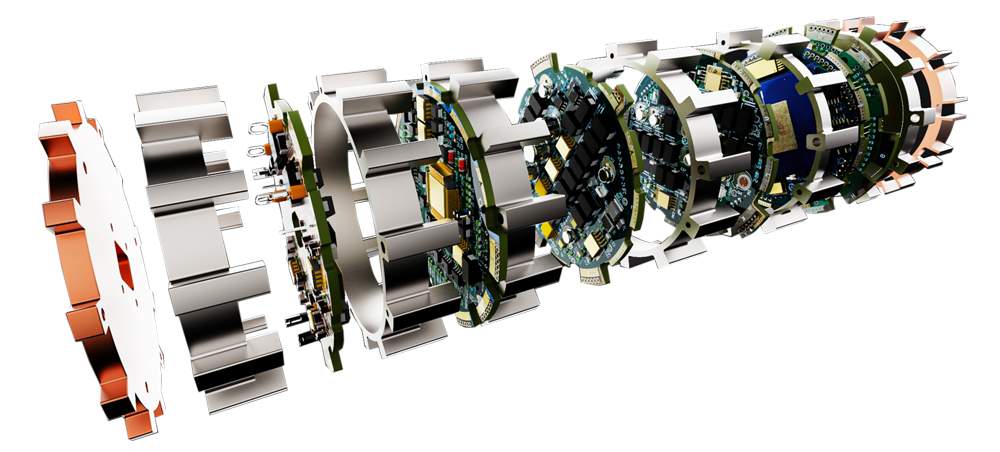
Designing electronics capable of operating reliably at ultra-high temperatures requires addressing several fundamental thermal challenges. First, electronic assemblies must be protected from the extreme external temperatures encountered in deep geothermal wells. Second, internally generated heat must be removed efficiently to prevent localized overheating. Finally, rejected heat must be transferred to regions where it will not damage surrounding components or degrade system performance.
Traditional downhole electronics typically use long, rectangular circuit boards that dissipate heat relatively slowly. To overcome this limitation, Hephae developed a circular stacked circuit architecture designed to accelerate radial heat transfer, Fig. 1.
Each circular board is surrounded by a thermally conductive ring that, when assembled into a stack, forms a continuous pathway for heat to travel axially along the tool body. This structure acts as a “thermal superhighway,” rapidly transporting heat away from sensitive components toward cooling interfaces, such as the pressure vessel or drilling fluid.
By minimizing temperature gradients within the electronics package, and reducing temperature differences between the electronics and the external environment by up to an order of magnitude, compared with designs that are not thermally optimized, the system improves component longevity, stability, and operational reliability. All electronic assemblies have undergone extensive laboratory testing under extreme temperature conditions.
Temperature is only one of several challenges facing drilling systems operating in deep geothermal wells. Hard crystalline formations introduce severe mechanical stresses that can rapidly damage sensitive electronics and mechanical assemblies.
To validate system durability, Hephae conducted extensive Highly Accelerated Life Testing (HALT) across a range of combined stress conditions. Testing included sustained operation at temperatures exceeding 230°C, triaxial vibration levels up to 30 G RMS, pneumatic shock events exceeding 1,000 G, and multi-axis dynamic loading representative of crystalline basement drilling environments.
According to Bob Joyce of DynaQual, who oversaw elements of the testing program, “Hephae’s HALT testing at temperatures exceeding 230°C is among the most robust testing programs we have seen applied to a downhole electronics package.”
THE ECONOMICS OF WHY TEMPERATURE MATTERS
The economics of geothermal energy are directly tied to temperature. “When it comes to the economics of why hotter is better, every degree matters” states John Clegg, CTO of Hephae. Higher temperature resources yield dramatically more energy per well, slashing the levelized cost of electricity (LCOE) to make geothermal cost competitive with fossil fuels.
Next-generation geothermal technologies like enhanced geothermal systems (EGS) and advanced geothermal systems (AGS) aim to extend access to heat anywhere by creating engineered reservoirs underground. As Jenna Hill of CATF explains, “When next-generation geothermal systems are pushed to superhot rock conditions, they could significantly boost power potential and reduce costs, with each well producing five to ten times more power than today’s conventional geothermal projects.” That shift would turn geothermal into a true global energy powerhouse.
The economics extend beyond power generation. Every day on a drilling rig carries a price tag of hundreds of thousands of dollars, making reliability paramount. As I have stated before, traditional Measurement While Drilling (MWD) systems are not rated to the extreme temperature and stress conditions associated with superhot rock geothermal, forcing costly delays and equipment replacements that can add millions to project budgets.”
High-performance MWD systems, like those under development at Hephae, reduce downtime, improve well placement, and cut days off drilling schedules, driving measurable savings and accelerating project timelines. Tony Pink of Pink Granite Consulting notes that “Mazama Energy has developed the world’s hottest enhanced geothermal system, reaching 331°C, using cooling techniques and insulated piping. As Mazama advances, high-temperature MWD systems will be critical to drilling deeper, hotter wells while reducing costs and operational risks.”
Through the deployment of ultra-high-temperature tools, significant cost reductions in drilling are achieved by reducing the non-productive time spent cooling the well and cutting down tool failures caused by overheating electronic components. These drilling efficiencies are estimated to save upwards of $1 million per well.
The global race to scale superhot rock geothermal is underway. CATF reports that more than two dozen wellbores have been drilled worldwide, many within existing geothermal fields. These early efforts demonstrate that the pathway toward reaching superhot rock temperatures above 400°C is well underway and represent a critical threshold to unlocking terawatt-scale energy output.
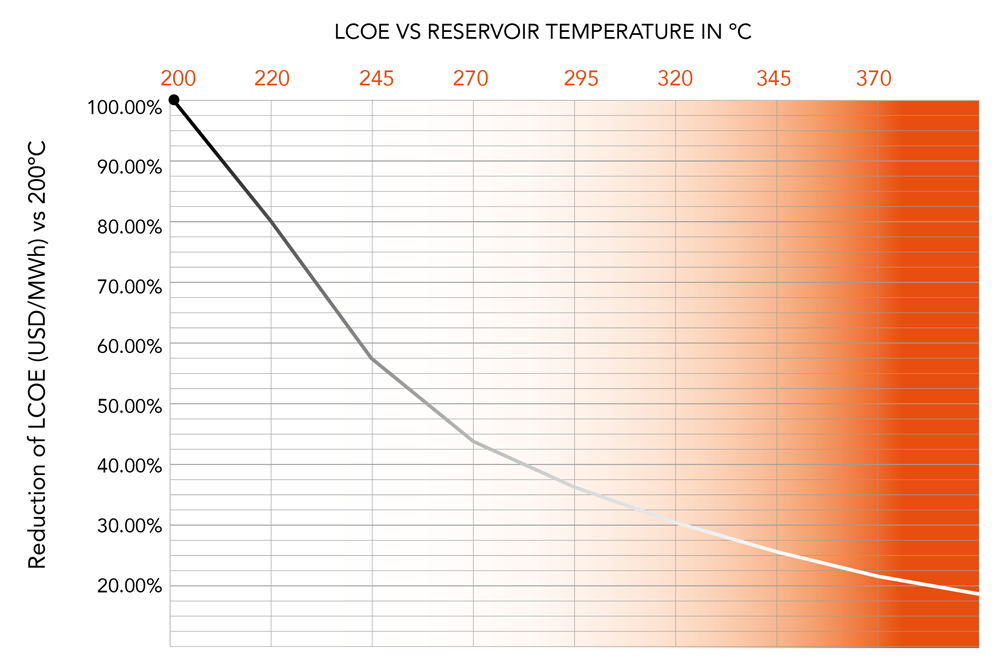
Even modest increases in reservoir temperature can have a profound impact on project economics. Increasing reservoir temperature from 170°C to 210°C can reduce the levelized cost of electricity (LCOE) or cost per kilowatt hour by approximately 25%. At even higher temperatures, particularly above the supercritical threshold of 374°C, water behaves differently, carrying exponentially more energy from the formation to the surface, Fig. 2.
This fundamentally changes the economics of geothermal development. Fewer wells are required to generate the same amount of energy, reducing overall drilling costs and lowering project risk. CATF estimates that superhot rock geothermal could eventually produce electricity at costs between $20 and $35 per megawatt-hour at scale, positioning geothermal to be cost-competitive with other major forms of power generation.
Recent research from CATF demonstrates that drilling costs for enhanced geothermal systems have steadily declined over the past five decades. Continued improvements in drilling technology could accelerate this trend further.
FIELD VALIDATION AND COMMERCIAL DEPLOYMENT
Hephae’s Pandora210™ system has demonstrated successful field performance, validating its ability to operate reliably in high-temperature drilling environments. Results confirm that the system’s high-temperature electronics and thermal management architecture perform, as designed, under real downhole conditions. These initial deployments represent an important step in translating lab-scale validation into operational performance in the field. Building on this success, additional field trials are scheduled with next-generation geothermal operators in the coming quarter, including Mazama Energy in Oregon.
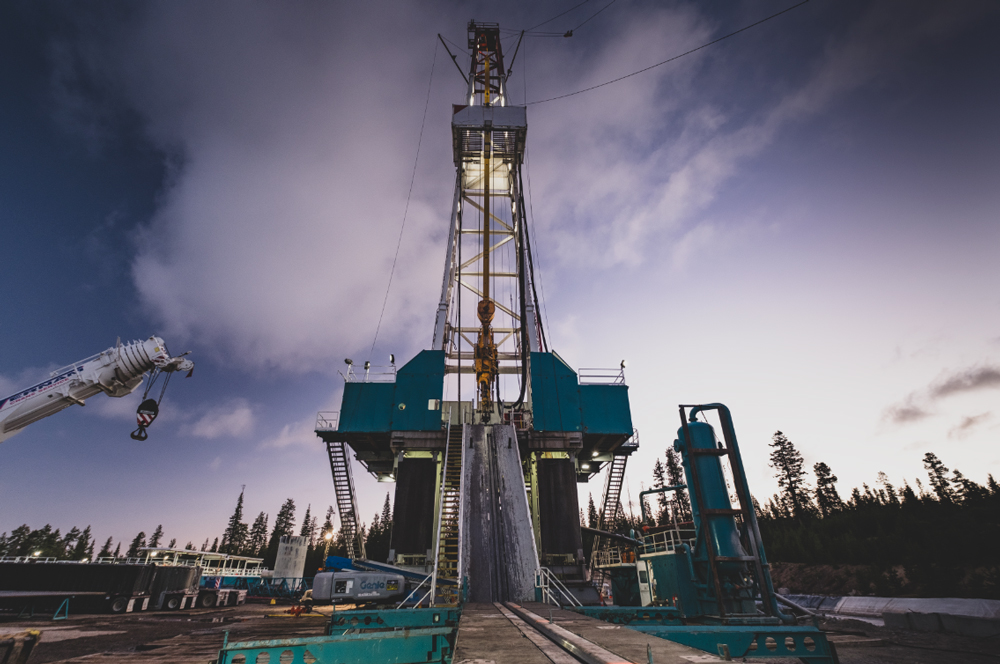
Field trials will continue to further advance the commercial readiness of ultra high temperature directional drilling technologies for deeper and hotter geothermal applications, Fig. 3.
THE NEXT FRONTIER: ULTRA-HIGH TEMPERATURE RSS
Hephae is now advancing the next phase of development, engineering directional drilling systems capable of operating at temperatures approaching 300°C circulating temperature by 2030. Reaching these temperatures will open the door to developing superhot rock resources, capable of delivering significantly greater energy output per well.
As geothermal development advances, well architectures are also evolving. Projects are increasingly drilling longer laterals and larger diameter wells to maximize reservoir contact and energy production, a trend already visible in projects, such as those developed by Fervo Energy. As geothermal wells grow in length and complexity, high-temperature MWD-RSS integration, led by Hephae Energy Technology, will play a critical role in enabling continuous directional control, improving well placement accuracy and drilling efficiency in hard crystalline formations. Development of high-temperature RSS components is currently underway. The goal is to deliver the first commercial ultra-high-temperature RSS for geothermal by 2027.
CATALYZING INVESTMENT IN SUPERHOT ROCK
Technology breakthroughs in high-temperature drilling do more than enable future projects, they reshape the economic landscape for geothermal investment. By enabling access to deeper, hotter reservoirs, high-temperature drilling systems create a powerful economic incentive to pursue superhot rock resources.
A recent analysis from the International Energy Agency (IEA) draws on exclusive data from Underground Ventures, a lead investor in Hephae Energy Technology, which demonstrates that financing for next-generation geothermal reached nearly $2.2 billion in 2025, representing an 80% year-over-year increase and a sharp rise from $22 million in 2018, Fig. 4. As stated by Torsten Kolind, Co-Founder and CEO at Underground Ventures, “Geothermal’s time has come, and new technology is saving the day,” with their funding “supplying the largest geothermal developers on the planet with tech that lowers cost, risk and time to production.”
A GLOBAL ENERGY OPPORTUNITY
The global race to develop superhot rock geothermal is gaining momentum. Governments, research institutions, and private companies are investing in new drilling technologies, field demonstrations, and high-temperature materials research. Superhot rock geothermal wells are on the rise worldwide, representing critical milestones in demonstrating the feasibility of accessing temperatures exceeding 400°C.
In the United States, this momentum is being reinforced by major public investment, including the U.S. Department of Energy’s recently announced $171.5 million funding opportunity to accelerate geothermal technology development and resource validation. Achieving these goals will require continued collaboration between the geothermal and oil and gas industries, combining decades of drilling expertise with advances in electronics, materials science, and thermal management.
UNLOCKING THE HEAT BENEATH OUR FEET
Superhot rock geothermal represents one of the most promising frontiers in the global energy transition, with the potential to produce significantly more power per well and create a pathway for geothermal energy to scale to new heights, as a globally deployable source of clean, firm power. Today, the 200 °C temperature barrier in directional drilling has finally been broken, an engineering challenge that industry leaders have pursued for more than 25 years. Advances in high-temperature electronics, drilling systems, and field demonstrations are moving superhot rock geothermal from concept toward reality. The heat beneath our feet is immense. If the industry can continue pushing deeper into these extreme environments, the immense heat stored within the earth’s crust could unlock gigawatts of reliable, carbon-free energy.
STEVE KRASE is a geoscientist and drilling technology innovator with over 45 years of experience pushing the boundaries of subsurface energy systems. As Co-Founder and CEO of Hephae Energy Technology, he is advancing ultra-high-temperature drilling technologies that enable access to deeper and hotter rocks, enhancing the economic viability of geothermal energy development.
Related Articles- Drilling technology: Drill bit advances continue their relentless march forward (March)
- Integrating real-time drilling analytics to reduce carbon intensity and operational risk (March)
- Drilling advances: Gas: What’s a mother to do? (March)
- U.S. drilling to remain disciplined in 2026 amid flat rigs, steady output (February)
- Middle East jackup fleet continues to shrink following Saudi suspensions (February)
- From impossible to inevitable: Superhot rock geothermal to unlock gigawatts of energy (January)
- Subsea technology- Corrosion monitoring: From failure to success (February 2024)
- Applying ultra-deep LWD resistivity technology successfully in a SAGD operation (May 2019)
- Adoption of wireless intelligent completions advances (May 2019)
- Majors double down as takeaway crunch eases (April 2019)
- What’s new in well logging and formation evaluation (April 2019)
- Qualification of a 20,000-psi subsea BOP: A collaborative approach (February 2019)