FORD BRETT, CONTRIBUTING EDITOR
The last two articles in this series showed that U.S. natural gas demand is poised for significant growth through 2030…driven by a doubling of LNG export capacity and surging electricity from A.I. and data centers. Together, these forces are expected to increase U.S. gas demand by roughly 30 Bcfd, a 25% jump and the fastest growth the industry has ever had to deliver.
Unlike the past decade, when much of the incremental supply was from associated gas (a by-product of unconventional oil drilling), future production must come from dedicated gas wells. This will require adding approximately 120 to 180 more gas-targeted rigs to today’s fleet.
The good news is that our traditional barriers are no longer constraints. The industry knows where the gas is—U.S. unconventional resources are vast and well-mapped—and drilling and completion performance has improved dramatically, with production per active drilling rig rising roughly eight-fold since 2010. Technology and subsurface knowledge are not the issue. We do have constraints, and from my perspective, three major bottlenecks threaten the industry’s ability to deliver 30 Bcfd:
- Midstream constraints. Production growth requires parallel expansion in gathering and transmission pipelines, processing, compression and storage. The lead time for key items, legal challenges, and export-focused infrastructure, risks leaving producing regions bottlenecked and producers exposed to having gas that can’t be delivered to the market. (Brett editorial comment: As drillers, we can just wait around for the midstream folks to get their act together before we drill—one theme of this article is that Drilling Advances can play a part in making the Midstream challenge more manageable.)
- Permitting and regulatory friction. In some key gas regions, particularly the northeastern U.S., permitting timelines are prolonged by political opposition, environmental requirements, and litigation. Methane regulations and other environmental rules add further cost and delay. (Brett editorial comment: This bottleneck is not normally considered a “Drilling Problem,” but New York’s ban on drilling and pipelines proves the point—no permits, no gas. Drillers can’t solve this, but they must help.)
- Performance degradation when activity ramps up. Every historical surge in rig count has been followed by a drop in drilling efficiency—an effect driven not by equipment scarcity but by the time and expertise required to rebuild high-performing crews. This “performance twist-off” can cost $3 million to $5 million per rig and represents a billion-dollar challenge at scale. (Brett editorial comment: This bottleneck won’t prevent the wells from being drilled but is the most significant, pure “drilling” barrier to getting 30 Bcfd to the market economically.)
These bottlenecks—not geologic uncertainty —will determine whether the industry can meet the nation’s rapidly rising demand. The next few articles in this series will explore what drillers can or can’t do about these bottlenecks to meeting gas demand. After addressing the U.S. bottlenecks in the next few articles, I plan to explore which Drilling Advances could meet the even bigger growing gas demand in “most of the World.”
Refer to my last columns if you are interested in the details supporting why I think this growth will happen. I try to make each of these helpful as stand-alone missives, but there is a red thread running through them all, and prior articles might be useful for new readers.
What can drillers do about the midstream and regulatory friction? It might seem like all drillers can do is stand by and await midstream and permitting guys to get their act together. While it is true that drillers can’t solve these problems alone, one key drilling advance, longer laterals, does make them easier to manage.
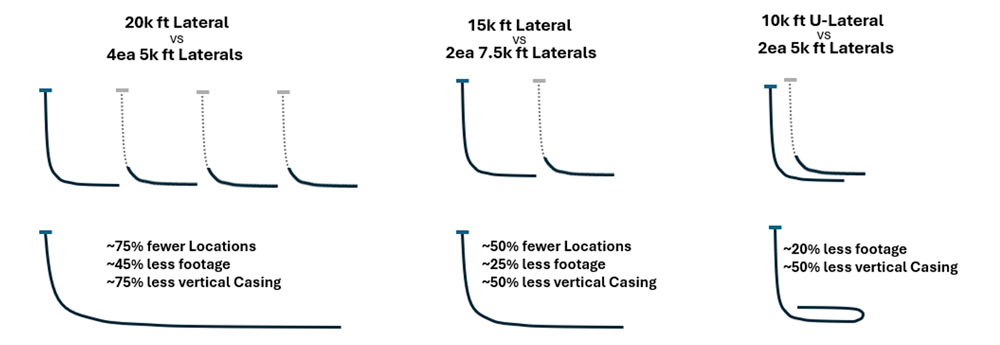
Figure 1 illustrates how longer laterals can work to make the lives of our brothers and sisters in surface facilities, midstream and permitting easier. Longer laterals reduce the number of wells and increase production per well at a lower cost. This means fewer surface locations, shorter gathering lines, less right-of-way, fewer permits, and scale make operations safer and easier to manage than more dispersed, smaller isolated locations. Fewer locations make the gathering and processing technically easier and reduce the impact on the surface. This doesn’t eliminate permitting challenges, but it does reduce their number.
SLIGHT DETOUR: U-LATERALS – HUH?
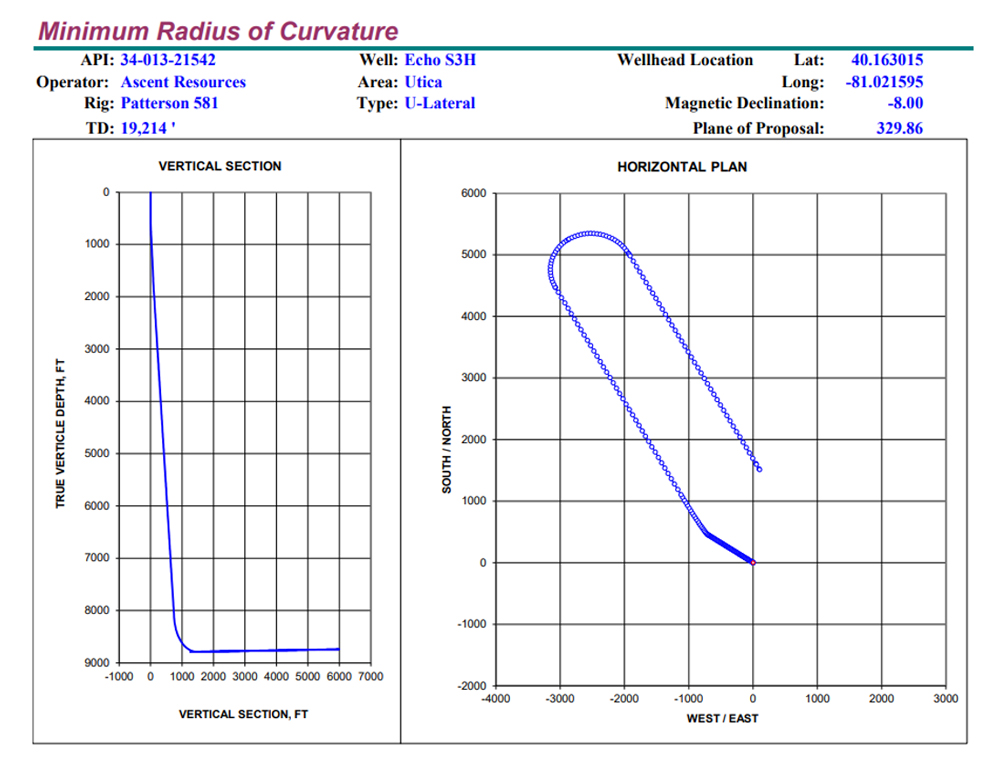
What in the world is a U-Lateral? And why would you want one? We don’t have enough time to go deep into U-Laterals in this column, but briefly, Fig. 2 shows the wellbore survey from publicly available survey data from a U-Lateral well in the Utica shale. U- Laterals start out normally by drilling maybe a 5,000-ft lateral and then, oddly, do a 180o turn and drill a twin lateral coming back the other way. Over 300 U-Laterals have been drilled since Shell drilled the first one in 2019. Applications grew slowly for several years but have since skyrocketed. In 2025 more than 250 were drilled.
OK, cool… but why would anyone ever want to drill one? U-Laterals are helpful, when it is not possible to drill a longer lateral, due to lease boundaries. They are cheaper than drilling a twin because, as shown in Fig. 1, they eliminate the vertical portion of one well and its associated wellhead, surface/intermediate casing costs.
There are also advantages when it comes to interference effects from fracture stimulation, and from the costs of hooking up and maintaining a single wellbore instead of two. They reportedly, and very credibly, deliver increases in project returns of ~25% to 40% by saving the cost of $3 million to $4 million for every set of two wells. UDriller.com has several examples, along with typical economics and, importantly, why understanding torque and drag while drilling, tripping and running casing is critical to a U-Lateral’s success.
The point is that drillers can now make laterals REALLY long and go in weird ways. These longer laterals can help, oddly enough, with the midstream and permitting bottlenecks, because fewer, more productive wells, and fewer surface locations, make their lives easier.
How can longer laterals possibly help the midstream and permitting? While drillers cannot build pipelines and processing facilities, they can design drilling programs that reduce exposure to midstream timing and capacity risks. Longer laterals deliver more gas per well at a lower cost and clearly make the drilling part of the value chain more productive.
They don’t just make the drilling part better; gas processing guru Kindra Snow-McGregor lists the benefits of longer laterals to midstream and permitting as follows:
- Longer laterals mean fewer locations:
- Less right of ways for gathering/transmission lines creates less land issues and means less permitting. (Brett Editorial comment: In the Appalachians, a foot of horizontal lateral can cost $250 to $350 to drill and case. That’s cheaper than over $500 per foot of pipe on the surface.)
- Fewer neighbors and surface rights are needed at less cost. It’s easier to keep the fewer surface owners happy since they could be better compensated with equivalent project economics.
- Lower total footprint means fewer overall land issues and less impact on the environment.
- Longer laterals mean larger volumes at each location:
- Justify redundancy, spare capacity, and process safety considerations, such as flares that might be too costly on lower-volume operations.
- Allow for processing on site to mitigate corrosion and hydrate inhibition cost and maintenance issues, as compared to multiple well pads with a large gathering system.
- Make it easier and less costly to handle or monetize any NGLs and make NGL equipment cheaper/easier; for example, eliminating the need for large slug catchers (in case of rich gas).
- Fewer total sources of release, which makes it easier to deploy low-emission drilling technologies. Dual-fuel gensets, grid-powered rigs, and methane tight surface equipment directly support the regulatory environment and accelerate approvals.
- Lower operating cost per Mcfd, with a central location for operations and maintenance.
- Likely lower staffing requirements per Mcfd is inherently safer.
- Make development and project planning more agile, by helping to manage takeaway constraints. Because laterals exceeding 15,000 ft are now drilled routinely and cased in ~25 days in plays like the Marcellus, drilling strategies can balance EUR against regional takeaway capacity.
In short, with longer laterals, drillers can synchronize well delivery with midstream availability, dampening the risk that pipeline delays cascade into production losses.
Example case study: How longer laterals would help the midstream and permitting.
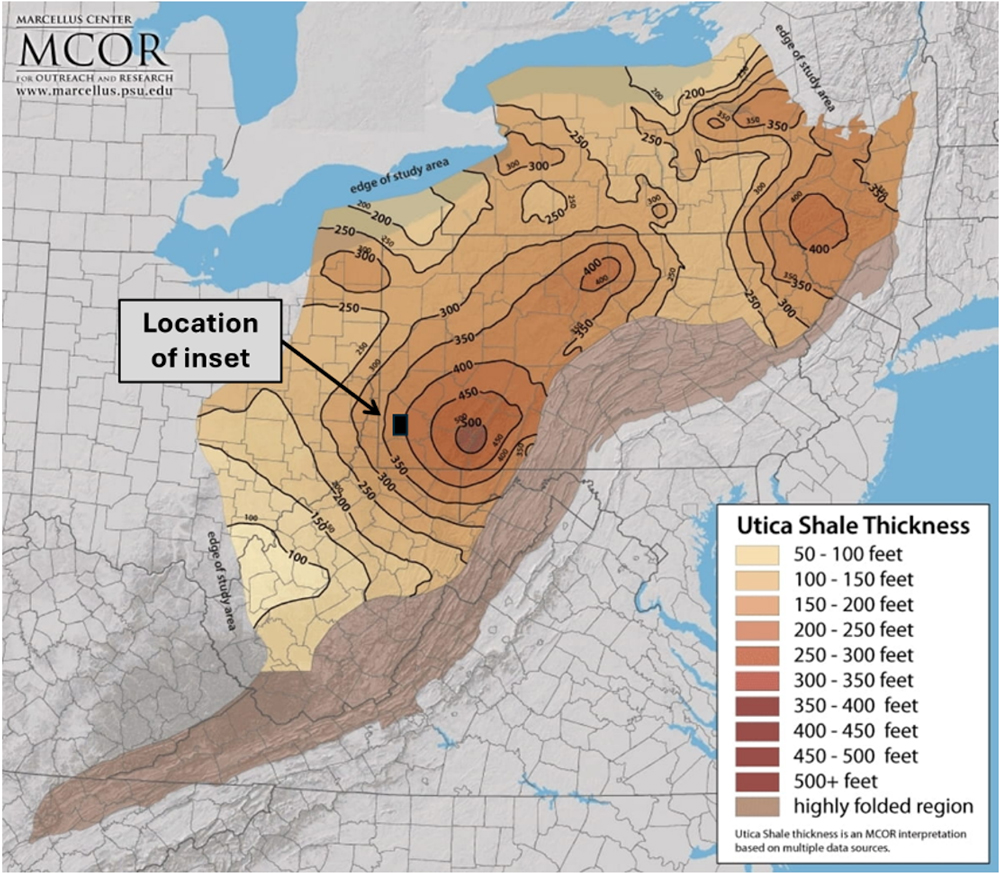
Drillers can’t solve the midstream and permitting bottlenecks that we face, but Drilling Advances do make the situation more manageable. Figures 3 and 4 illustrate how this would work in a real situation. Figure 3 shows a regional map of the Utica shale in the northeastern U.S., along with the location of an area of interest zoomed into, in Fig. 4.
Figure 4 shows the locations of 19 well pads, indicated by the gold stars, in an area of roughly 4 by 6 mi. Those pads had two to eight wells per pad, with a total of 120 or so wells to develop the area. Notably, the terrain shown in Fig. 4 is typical for the entire Appalachian region, with 350-ft (100-m) hills with 20% to 25% grade. Also shown in Fig. 4 is a diagram of how a pad with 7.5k-ft laterals could develop an area of 3 mi2. Using the longer laterals, as shown in the inset, would have reduced the number of locations from 19 to 8.
A plan with 15k-ft laterals would have reduced the number of surface locations by 19x.
With 15k ft-laterals, the entire 24-mi2 area could be developed from one pad with 40 to 64 wells, depending on lateral spacing (of say 600 to 1,000 ft). The area was developed with 5k-ft laterals and took some 120 with 19 locations.
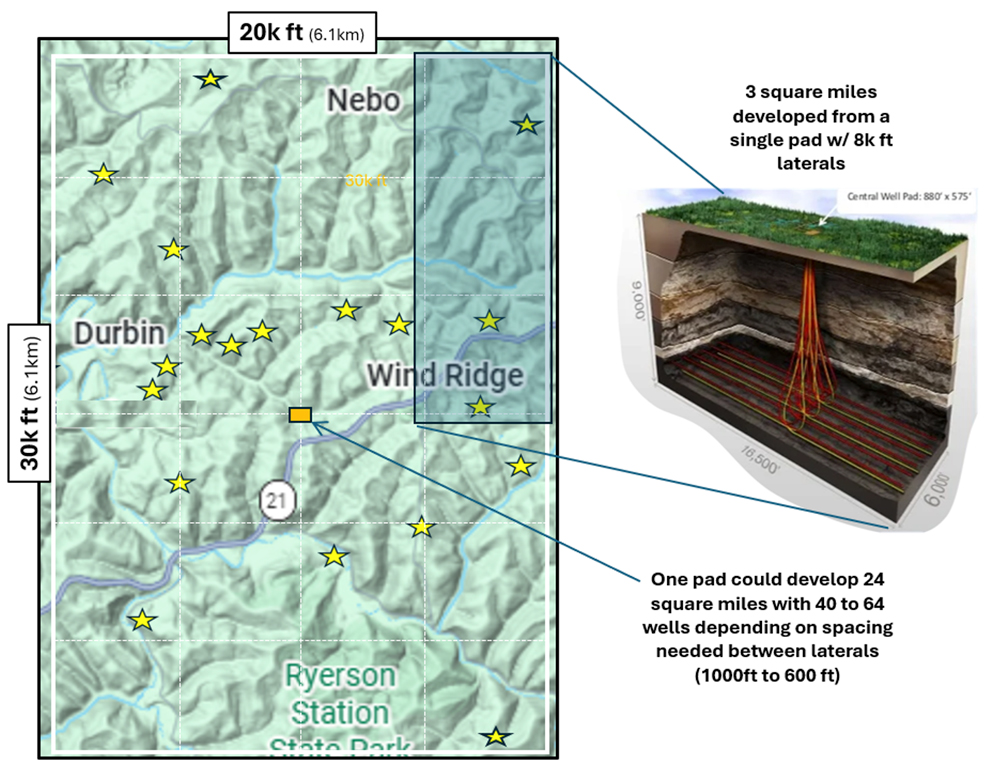
One central location would, of course, need to be larger, but it would replace 18 to 24 smaller locations. That’s important anywhere, but particularly in the Appalachians, where the topography is no joke. Locations cost 10x to 20x more than in the Midcontinent, gathering lines are 2x to 5x more expensive, land and legal for right-of-ways is difficult from 18th century surveys, as the basis for titles.
This idea wasn’t invented here. Antero Resources and Range Resources, and no doubt others, have developed pads with 20 to 40 wells for just this reason. The point I’m making is that 15k-ft to 20k-ft laterals help make the midstream and permitting folks’ lives easier in several important ways. We don’t fix their bottlenecks, but it does help.
But everything isn’t all coming up roses. More wells and the required surface facilities at a single location have some downsides. Among them:
- Planning and operations will be more complex for all phases of our business—land/legal, G&G drilling, completion, production and facilities groups will need to work much more closely. The savings and advantages that economy-of-scale provides will require greater teamwork, not less. Project execution is more critical with more moving parts—someone will need to coordinate all this. Drillers will need to play a key role in that coordination.
- Will need more capital. Projects like these will need a commitment to 40 to 60 wells to achieve the economies of scale. Returns will be higher, but so will total investment needed. Less capital per Bcfd, but to achieve economies-of-scale, greater capital commitments will be required. That will mean only the larger players winning, or more partners to achieve economies-of-scale.
Conclusion: Drilling as the anchor of the 2030 gas expansion. The U.S. has the resource abundance and the technical capability to deliver the next 30 Bcfd of gas production. What stands in the way are bottlenecks rooted not in geology but midstream buildout and infrastructure alignment, and regulatory friction and human performance.
Drilling is uniquely positioned to help address midstream and permitting bottlenecks, because longer laterals facilitate economy-of-scale on the surface facilities, and support permitting by reducing the number locations needed with transparency, predictability, and cleaner operations. If the industry succeeds, drilling will not simply be a cost center. It will be the critical enabler of delivering the gas needed to meet exploding demand.
We’ve yet to address what drillers can do about performance degradation when activity ramps up. The next column in this series will look at what we can do to accelerate crew competency and minimizing performance losses as we ramp back up.
Until next time, I hope to start a conversation with any of you on how we can all help Drilling Advance. If you have any questions, ideas, comments or corrections please email me at ford.brett@petroskills.com, and I promise I’ll respond.
Related Articles- Drilling technology: Drill bit advances continue their relentless march forward (March)
- Integrating real-time drilling analytics to reduce carbon intensity and operational risk (March)
- Start-up breaks temperature barrier in directional drilling, a challenge pursued for years (March)
- U.S. drilling to remain disciplined in 2026 amid flat rigs, steady output (February)
- Middle East jackup fleet continues to shrink following Saudi suspensions (February)
- Drilling advances: Bottlenecks? What bottlenecks? (January)
- Subsea technology- Corrosion monitoring: From failure to success (February 2024)
- Applying ultra-deep LWD resistivity technology successfully in a SAGD operation (May 2019)
- Adoption of wireless intelligent completions advances (May 2019)
- Majors double down as takeaway crunch eases (April 2019)
- What’s new in well logging and formation evaluation (April 2019)
- Qualification of a 20,000-psi subsea BOP: A collaborative approach (February 2019)