Unlocking the true potential of FPSO operations with a contextual digital twin
TOM BRIAN, Aize
For upstream operators, the biggest question isn’t whether to digitalise—it’s how to get started. As Aize’s experience shows, there’s enormous untapped value in simply getting the basics right. These truths certainly apply to FPSOs, just as much as other upstream functions.
WHY DATA ALONE ISN’T THE ANSWER
The oil and gas industry has never had a shortage of data. But for the technicians, planners and engineers responsible for operating critical infrastructure like FPSOs, having data isn’t the same as having access. It’s a daily reality: valuable time is lost, not due to poor tools, but due to fragmented ones.
When “digitalisation” became the buzzword across the sector, early efforts leaned heavily into the potential of advanced data science and custom-built solutions for niche problems. But while those brought flashes of value, they too often missed the mark, because they skipped over the most foundational need of all—finding information when you need it. As an engineer in the industry in the 2010s, I felt this pain—a frustration that despite these “digitalisation” efforts, it was still really difficult to get the data I needed to do my job.
Fast-forward a decade and for too many, this is still the case. Our studies at Aize suggest that the average oil and gas engineer spends upwards of 90 minutes per day searching across various systems for the data he/she needs to simply begin a task. That’s before any decisions are made or any value is delivered. On offshore assets like FPSOs—where bed space is limited, personnel are costly, and the stakes are high—this inefficiency compounds into significant operational drag.
The core issue isn’t a lack of innovation; it’s a lack of integration. Engineers and technicians simply do not have an easy, unified way to access the information they need across maintenance systems, P&IDs, document databases, safety systems, and equipment registers. Solving this doesn’t require a moonshot. It requires a solution built around the way real users think and work. And that’s where Aize enters the picture.
THE CASE FOR CONTEXTUAL DIGITAL TWINS
At Aize, we believe the future of oil and gas operations doesn’t start with the most complex solutions—it starts with context. Our approach focuses on giving engineers and planners an intuitive, unified view of the asset they are responsible for managing. This is delivered through a contextual digital twin: a dynamic digital representation of the FPSO that integrates 3D spatial models, engineering data, tag registers, P&IDs, and document repositories.
This isn’t just a “3D viewer” or a fancy interface. It’s a working environment that mirrors how engineering teams think. It allows users to move fluidly from a physical location on the FPSO to the underlying data, or from a tag to associated work orders, documents, and condition reports. It allows remote teams to collaborate, as if they were on board. It builds operational confidence, unlocks efficiency, and reduces risk—without asking the workforce to change how they think or retrain how they work.
SAVING TIME, EVERY DAY
One of the most immediate and measurable impacts of the contextual twin is time saved. Instead of navigating complex document management systems or sending messages offshore to confirm equipment details, users can go straight to what they need.
An engineer needing the specification of a pump, for instance, can search by tag, pull up the associated documentation, view the component in 3D, and confirm its spatial location—all in a matter of seconds. With Aize, the time required to locate critical equipment has been shown to drop by 50%, saving thousands of engineering hours per year for large operators.
This is not just about convenience. In offshore operations, time saved equals downtime avoided, better planning accuracy, and safer execution. Small changes in efficiency at the individual level quickly scale into operational gains at the asset level.
ENABLING REMOTE PLANNING AND EXECUTION READINESS
Historically, planning offshore work has often required sending someone to the vessel to take measurements, confirm equipment locations, and assess access. But with Aize, these tasks can increasingly be performed from onshore.
Engineers can visualise where equipment sits in both spatial (3D) and process (P&ID) contexts, evaluate isolation requirements, and even mark up scaffolding or access zones for upcoming tasks. For example, identifying whether an overboard cover is needed or if there’s sufficient clearance for lifting operations can be done using recent 360° reality capture integrated into the Aize platform. These may seem like simple tasks but without the right tools and a requirement for someone on site to confirm, they can quite quickly take days to reach same conclusion.
In one instance, a maintenance team used Aize to plan a complex changeout. What would typically have required sending a technician offshore—with a 1–2-week lead time for logistics—was completed in under an hour. This not only enabled the work to move forward faster, but it freed up critical helicopter and accommodation resources.
GOING BEYOND BASICS: INTEGRATING MAINTENANCE AND INTEGRITY SYSTEMS
Once users have access to foundational data—3D models, tags, engineering specifications, and P&IDs—the next layer of value comes from bringing in live maintenance and integrity data. This includes open work orders, inspection findings, operational actions, and historical interventions.
With this integration, we create a living, breathing representation of the asset: one where every work activity and every historical anomaly is connected to the equipment it affects. This reduces the noise of traditional systems and helps engineers focus on what matters most in their operational zone.
BENEFITS OF EQUIPMENT-BASED CONTEXTUALISATION
With equipment-based contextualisation, engineers can streamline their workflows by searching for work orders, using familiar tag references instead of navigating cumbersome CMMS interfaces. This approach drastically reduces the time and effort needed to locate operational data. Once the relevant tag is identified, users can immediately visualise associated anomalies, outstanding actions, and historical operations—all directly within the 3D environment. This integrated, intuitive access to data ensures that engineers are always working with the full picture, leading to better-informed decisions and more efficient execution.
NESTING, SEQUENCING, AND 4D PLANNING
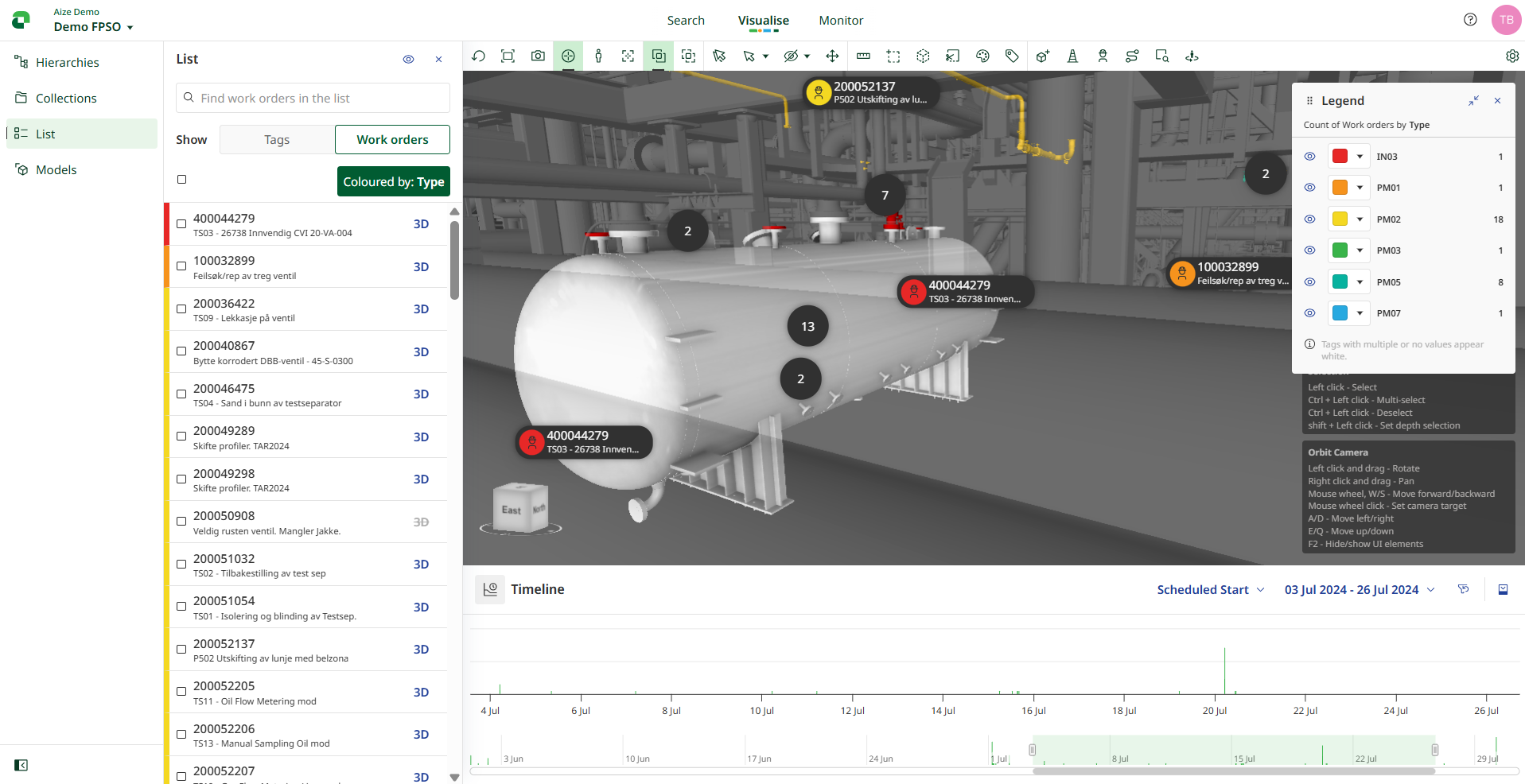
As work order data is mapped to the 3D model (Fig. 1) and P&IDs, users gain the ability to optimise work sequencing—a process often referred to as “nesting” or “bundling.” In practical terms, this means grouping tasks spatially or based on shared isolation requirements to maximise productivity and reduce downtime.
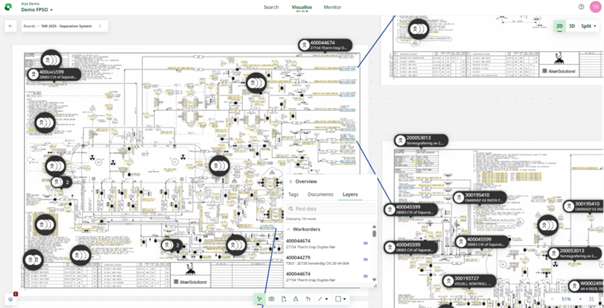
Imagine a planner visualising multiple upcoming tasks in the same area of the vessel. Instead of dispatching teams to the same area multiple times, Aize allows them to cluster tasks and complete them in a single, optimised work sequence. Similarly, viewing scheduled maintenance on the P&ID helps identify work that can be bundled, based on common process boundaries, Fig. 2.
The introduction of time as a variable—4D planning—takes this even further. By animating work over time within the 3D environment, planners can spot SIMOPS clashes, validate tool time assumptions, and play through the entire sequence of events before a single wrench is turned, Fig. 3. In operations where every hour counts, this clarity is transformational.
REAL-WORLD IMPACT: USE CASES FROM THE FIELD
Turnaround planning. During turnaround (TAR) events, the stakes are especially high. Scope, sequence, access, and timing must all align. Aize is helping teams visualise their entire TAR workload early—long before scope freeze. This visibility enables scope optimisation, smarter sequencing, and risk mitigation.
Using Aize Collections, planners can mock up views of required scaffolding, define barrier zones, and mark laydown areas. One team operating in Guyana built a Collection around all overboard tasks, helping safety engineers visualise and evaluate exposure across the facility. By pulling in documents, work orders, and photos, each Collection becomes a portable, interactive work pack.
And once execution begins, offshore teams benefit, too. With full visibility into spatial and process plans, they spend less time orienting themselves and more time executing with precision.
Remote anomaly resolution. A team tasked with resolving an integrity anomaly recently used Aize to locate the tag, confirm access requirements via reality capture, take measurements, and determine whether scaffolding and permits were needed. All this was done from shore, within an hour. Previously, this work would have been deferred while waiting for offshore logistics. The result: faster readiness, lower costs, and higher utilisation of onshore expertise.
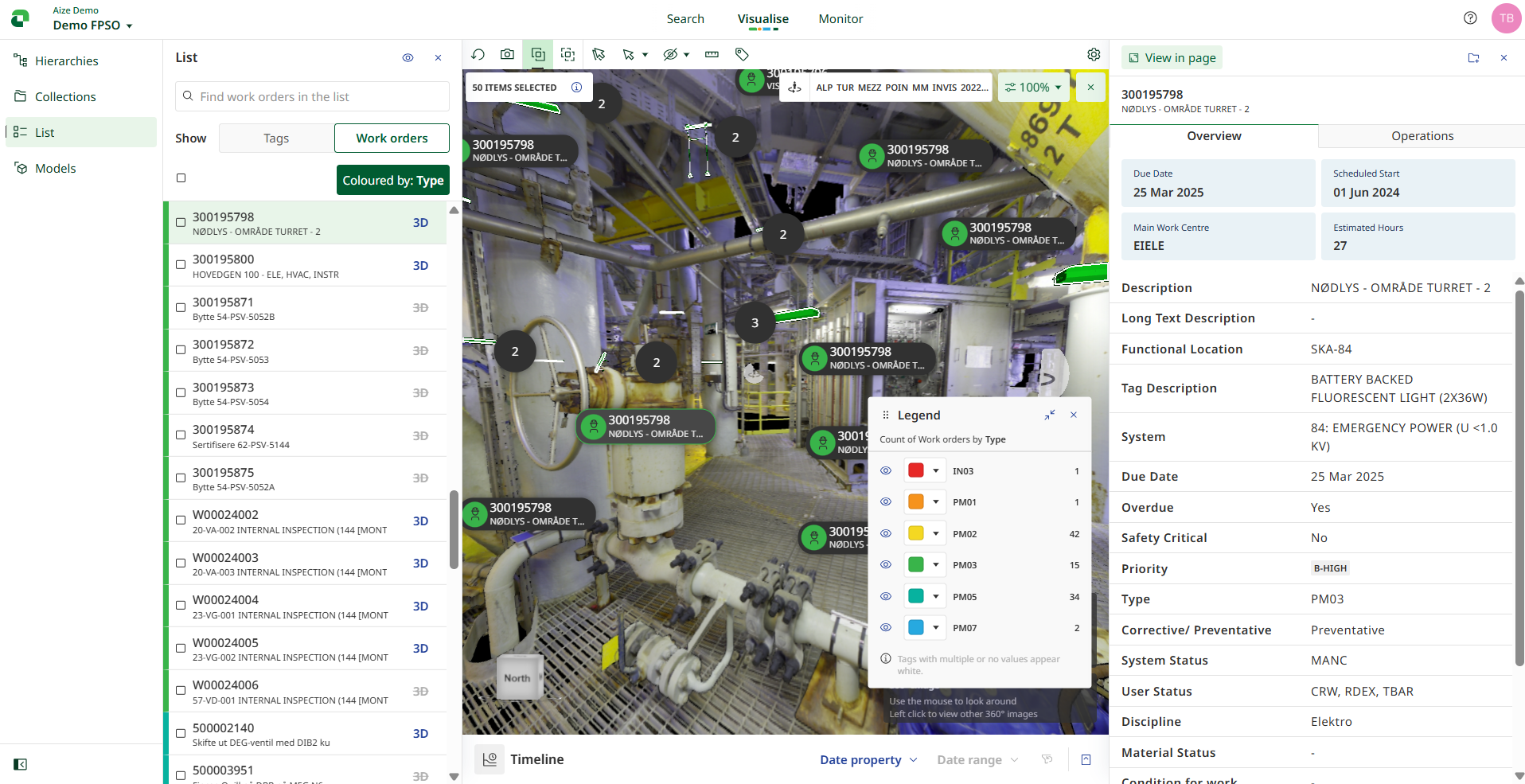
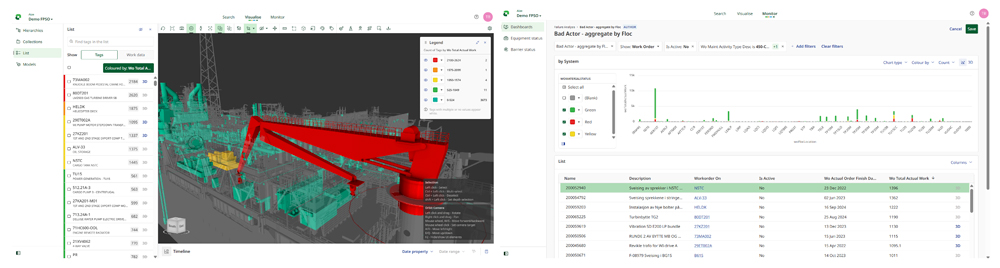
Bad actor analysis. With all work history tied to the tag and visualised in 3D, operators are now performing what we call “visual root cause analysis.” By heatmapping historical corrective work across the asset, one FPSO team identified clusters of repeat failures around a specific system, Fig. 4. This led to a targeted engineering review that uncovered a persistent issue—one that might have gone unnoticed in spreadsheets.
THE BIGGER PICTURE: PREPARING FOR THE AI FUTURE
Industry-wide, the vision for the future includes predictive maintenance, AI-driven decision support, and unmanned operations. But these advancements depend entirely on the quality, accessibility and structure of foundational data. A contextual twin doesn’t just enable efficiency today—it lays the digital foundation for tomorrow.
Operators, who start by bringing together their 3D model, tag register, and engineering data, gain an immediate benefit. But they also expose any data quality gaps that would otherwise silently block future use cases. By fixing those now—while also delivering value to the business—digital transformation becomes sustainable and self-reinforcing.
Although the basic steps are foundational that unlock first benefits, I’m convinced that with this foundation, massive digital transformation can occur. For example, with support for time series data in Aize, not only are engineers able to visualise where equipment on the facility is actually functioning, and visualise pressures, temperatures and flowrates across the facility, they can also do the same with synthetic data from machine learning models. This is the next step towards a world where automation and predictive maintenance is a reality.
CONCLUSION: START NOW, SCALE FAST
For many FPSO owners and operators, the biggest question isn’t whether to digitalise—it’s how to get started. The pressure to leap straight into advanced analytics and machine learning can be paralysing. But as Aize’s experience shows, there’s enormous untapped value in simply getting the basics right.
A digital twin helps your teams work smarter, plan faster, and reduce risk. It transforms data from a burden into a resource. And it does so in a way that fits into the way engineers, planners and technicians already think.
Your data is your competitive advantage. Make it accessible. Put it in the right context. And start now.
TOM BRIAN is a Principle Product manager at Aize, a software company delivering digital twin solutions to energy sector operators. With an industry background in drilling and wells engineering operations, coupled with product management, Mr. Brian champions practical innovation to solve real-world challenges faced by engineers and technicians.
Related Articles- Middle East jackup fleet continues to shrink following Saudi suspensions (February)
- State of digitalization in the oil and gas industry (February)
- Rugged, explosion-proof computers safeguard offshore rigs (January)
- The evolution of remote-controlled FPSOs (January)
- How AI-driven asset management is channeling the sea of data into actionable insights for companies (December 2025)
- Upstream benefits: Oil and gas networks for the digital era (December 2025)
- Subsea technology- Corrosion monitoring: From failure to success (February 2024)
- Applying ultra-deep LWD resistivity technology successfully in a SAGD operation (May 2019)
- Adoption of wireless intelligent completions advances (May 2019)
- Majors double down as takeaway crunch eases (April 2019)
- What’s new in well logging and formation evaluation (April 2019)
- Qualification of a 20,000-psi subsea BOP: A collaborative approach (February 2019)