Extended-length gas separation improves ESP stability in slug-prone Permian wells
ANDREA VALERO, MARCEL PEREDA, JUAN ATENCIA and FRANK CORREDOR, Halliburton
GAS-SLUG CHALLENGES IN UNCONVENTIONAL ESP APPLICATIONS
Unconventional reservoirs in the Permian basin frequently exhibit high gas/liquid ratios (GLR) and intermittent gas slugging, which create challenging intake condition for electric submersible pump (ESP) systems. When gas slugs reach the pump intake, liquid inflow can temporarily decrease or stop, which results in low-flow, no-flow, or deadhead conditions.
Sustained slug flow presents challenges in long horizontal wells with undulating laterals that promote phase segregation. Gas can accumulate at high points while liquid occupies low points. As drawdown increases, and the gas–to-liquid ratio rises, the production stream can transition from a relatively continuous multiphase mixture to an intermittent regime in which large gas pockets are separated by liquid slugs. This behavior can intensify as flow enters the vertical section, where restricted annular clearance around the motor can promote accumulation and coalescence. Intake conditions then consist of cycles of adequate liquid entry, followed by rapid gas-fraction increase and temporary liquid starvation. These disturbances often persist, because wellbore geometry and transient holdup behavior govern them, even when operating frequency, choke settings, or control tuning are adjusted.
Conventional gas-handling approaches often optimize performance to reduce gas carryover during mixed-flow conditions. During extended gas-dominant intervals, however, insufficient liquid may be available at the intake for any separator to process. Protective modes, such as gas-lock logic and proportional integral derivative (PID) controls, can only limit oscillations and prevent catastrophic upsets, but cannot maintain liquid continuity when inflow becomes intermittent. As a result, mitigation strategies for sustained slugging must address both separation efficiency and intake buffering during prolonged gas events. These intake interruptions appear directly in the electrical and mechanical response of the ESP system.
During these events, hydraulic loading on the pump stages decreases significantly. Reduced hydraulic loading lowers shaft load and motor current and produces transient electrical and mechanical responses. Because motor slip directly relates to load and current, reduced load conditions correspond to lower amperage draw, which matches observed field trends during no-flow events.
Extended periods of low-flow or no-flow operation introduce mechanical risks within the ESP. Inadequate liquid inflow compromises lubrication within the pump stages and allows metal-to-metal contact between rotating surfaces. This loss of lubrication increases friction, raises temperatures, and accelerates wear on internal components. In severe cases, these conditions can cause bearing seizure and subsequent shaft failure.
Prior installations showed the presence of failure mechanisms, where prolonged exposure to no-flow conditions produced excessive downthrust and mechanical damage within the pump assembly. Gas accumulation and prolonged gas holdup within restricted annular clearances can further increase motor temperature because gas has far lower heat capacity than liquid and provides limited cooling to the motor.
To address these challenges, Halliburton engineers developed the Hydro-Helical™ Slugger gas separator to maintain a more continuous liquid supply to the pump during transient slug events. The system increases available liquid volume at the intake and elongates the separation section, which reduces the duration and severity of no-flow conditions and stabilizes pump operation.

EXTENDED-LENGTH SEPARATOR DESIGN
The high-performance separator uses a stationary-helix inducer that promotes gas–liquid separation through controlled vortex flow. As multiphase fluid enters the separator, the helix generates centrifugal forces that direct liquid toward the outer radius and allow gas to migrate toward the center. This mechanism improves separation efficiency, particularly at higher flowrates where centrifugal effects increase.
The separator geometry extends beyond conventional through an elongated separation chamber with integrated liquid storage volume. This configuration functions as a downhole buffer that temporarily stores liquid during periods of reduced inflow caused by gas slugging. The stored liquid supplies the pump during transient no-flow events and reduces the impact of slug-induced flow disruptions.
Downstream-oriented gas exit ports limit gas reentry into the intake stream and further stabilize pump intake conditions. The extended geometry also increases residence time within the separator, which improves separation performance and reduces gas carryover into the pump stages.
In addition to mechanical separation, system-level design decisions support improved performance under slugging conditions. In several applications, operators selected a smaller-diameter motor to increase annular clearance between the motor and the casing. This increased clearance reduces gas holdup around the equipment, shortens effective gas-slug length, and promotes smoother gas pass-through during transient events. The smaller motor configuration also distributes heat over a larger effective surface area relative to load, which reduces localized overheating within the motor windings.
FIELD TRIAL CONDITIONS AND DATA ACQUISITION
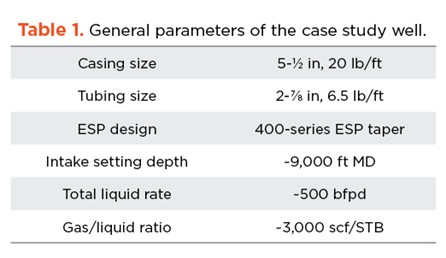
Field trials evaluated extended-length separator performance in multiple unconventional Permian basin wells with similar operating characteristics, including high GLR ratios, moderate liquid production rates, and intake depths near the kickoff point. Results discussed in this article were consistent across the evaluated wells, and Table 1 summarizes the parameters of one representative case-study well.
All installations used the Intelevate® digital platform, which captured high-resolution data at 30-sec intervals. Key parameters included motor current, motor and bottomhole fluid temperatures, pump intake pressure, tubing and casing pressures, vibration, and operating frequency. This high‑resolution dataset identified transient operating conditions associated with gas slugging and deadhead events and supported a detailed comparison of system performance before and after installation.
In addition to mechanical gas separation, selected operating modes supported stable ESP operation during transient flow conditions. PID control regulated motor load and mitigated rapid fluctuations during slug events. Gas‑lock mode protected the system during limited or absent inflow. Operators applied these strategies consistently throughout the evaluated wells as part of the overall mitigation approach.
Before installation of the gas separator, the wells experienced frequent no-flow events that lasted up to 60 min. These events coincided with rapid motor-load fluctuations, reduced current draw, and elevated motor temperatures. Repeated exposure caused multiple high-temperature shutdowns and contributed to mechanical degradation of ESP components.
ESP PERFORMANCE UNDER GAS-SLUG CONDITIONS
After installation of the extended-length separator, all evaluated wells showed improved operating stability and reduced exposure to no-flow conditions. Average no-flow duration decreased from 45 to 60 min. to less than 10 min. This reduction increased productive pumping time and improved system utilization from 50% to more than 95%.

Reduced no-flow duration directly influenced ESP thermal behavior. Shorter exposure to low-flow motor conditions limited internal heat generation caused by friction and reduced cooling. Measured motor temperatures declined substantially, with average operating values decreasing from approximately 250°F to approximately 170°F under comparable operating conditions, as shown in Fig. 2.
Motor current behavior also improved after the gas separator installation. Although transient fluctuations persisted, due to ongoing gas interference and slug flow, amplitude and variability of current draw decreased. This stabilization reflects more consistent hydraulic loading of the pump stages and reduced severity of slug-induced disturbances.
The reduction in no-flow duration mitigated prolonged periods of excessive downthrust. Because the separator maintained a continuous or near-continuous liquid supply to the pump, it preserved the lubricating film between internal components. This effect reduced mechanical friction and minimized the risk of bearing damage, shaft failure, and associated equipment downtime.
The observed performance improvements align with the underlying physical mechanisms. The extended intake section and increased liquid storage capacity delay the onset of complete liquid starvation during slug events. Even when gas reaches the intake, stored liquid continues to supply the pump and limits deadhead duration and associated mechanical and thermal stress.
SYSTEM DESIGN AND OPERATIONAL IMPLICATIONS
Production rates did not increase significantly in all cases, which reflects reservoir limitations, rather than equipment performance. In many wells, operators intentionally reduced operating frequency to maintain system stability under depleted reservoir conditions and high GLR ratios. These conditions align with Vogel-type inflow behavior, where additional drawdown produces diminishing incremental production gains.
Gas pockets and channeling within the reservoir further restrict liquid inflow and limit achievable production rates, regardless of pump configuration. Within these constraints, the separator improved operational stability by reducing harmful operating conditions and extending equipment run life.
Motor-size selection also contributed to improved thermal performance. Use of a smaller motor increased annular clearance, reduced gas holdup around the equipment, shortened the effective length of gas slugs, and improved heat dissipation. These factors, combined with reduced no-flow duration, lowered overall motor temperature and improved thermal margin during operation. To support this approach across varying completions and ESP configurations, the gas separator is available in 338- and 400-series sizes. These options allow size-matched deployment that preserves the intended intake geometry and annular clearance required to manage slugging behavior, promote phase distribution, and reduce motor exposure to low‑cooling gas.
CONCLUSIONS
The field trial demonstrates that the gas separator provides a reliable solution to mitigate no-flow conditions and improve ESP performance in unconventional wells affected by sustained slug flow and severe gas slugging.
The separator reduces no-flow duration and frequency, because it maintains liquid availability at the pump intake. This improvement stabilizes hydraulic loading, reduces motor temperature, and minimizes exposure to damaging operating conditions associated with excessive downthrust and inadequate lubrication.
Field results confirm significant improvements in productive pumping time, thermal performance, and system reliability. Although transient load fluctuations persist, due to inherent reservoir behavior, event severity and operational impact decrease substantially.
The results show that mechanical separation, combined with appropriate system design—including intake geometry, motor selection, and operating strategy—offers a practical, scalable approach to manage challenging flow regimes in unconventional ESP applications. In sustained slugging environments, conventional gas separators may reduce gas carryover during mixed-flow intervals but remain ineffective during extended gas-dominant slugs when insufficient liquid is present at the intake for separation to occur. The gas separator addresses this limitation by pairing separation with integrated liquid storage that buffers intake discontinuities and reduces time in liquid-starved operating regimes.

ANDREA VALERO is a solutions engineer for artificial lift with Summit ESP®, a Halliburton service, based in Houston, Texas. She holds a degree in geology and supports ESP performance and optimization in unconventional, conventional, and geothermal well applications.

MARCEL PEREDA is an applications engineer for artificial lift with Summit ESP®, a Halliburton service, based in Houston, Texas. He holds a degree in mechanical engineering and supports ESP performance and optimization, as well as ESP design in unconventional applications.

JUAN ATENCIA is a petroleum engineer with six years of experience in ESP systems. His background includes international roles in field services, shop work, applications, and remote monitoring for unconventional, conventional, and geothermal wells. Currently, Mr. Atencia leads an engineering team that handles ESP remote monitoring services for global clients as a Principal Technical Professional with the Summit ESP®, a Halliburton service, Intelevate® platform team.

Frank Corredor is an Artificial Lift Manager at Summit ESP®, a Halliburton service. He leads the Intelevate® digital platform for ESP surveillance and optimization. He specializes in data-driven monitoring, machine learning workflows, and remote operations to improve uptime and production performance. With over 16 years of experience in oil and gas, he has led the development and deployment of digital solutions that enhance ESP reliability and reduce downtime.
Related Articles- Shaletech Report: Permian activity remains steady with growth through efficiencies (April)
- Before OPEC, there was Texas: A better path for Venezuela’s oil revival (February)
- Dynamic kill operations in a legacy Texas oil field (December 2025)
- FlexRobotics hits the Permian: H&P’s robotic rig makes its field debut (December 2025)
- Water management: The New Mexico soap opera (November 2025)
- The ESG perspective: The rise of the Data Center: Part 2 (October 2025)
- Subsea technology- Corrosion monitoring: From failure to success (February 2024)
- Applying ultra-deep LWD resistivity technology successfully in a SAGD operation (May 2019)
- Adoption of wireless intelligent completions advances (May 2019)
- Majors double down as takeaway crunch eases (April 2019)
- What’s new in well logging and formation evaluation (April 2019)
- Qualification of a 20,000-psi subsea BOP: A collaborative approach (February 2019)