Tethered BOP technology enables DP rigs to drill in shallow water
KEVIN CHELL and KIM MITTENDORF, Trendsetter Vulcan Offshore and JAMES BREKKE, Brekke Offshore Consulting
THE LAY OF THE LAND
Normally, moored rigs are used to drill wells in water depths of 1,500 ft (457 m) or less, because once securely positioned, they hold their station reliably over the wellhead. Using a DP rig in place of a moored unit at these depths introduces station-keeping challenges that can lead to unsafe conditions, as small excursions from the well center can induce large loads into the subsea well.
With the unavailability of capable moored semisubmersibles in certain regions like the Gulf of Mexico (GOM)/Gulf of America (GOA)—due to fleet scrapping and hurricane performance issues—there is a need to fill the gap between units drilling in deep water (>3,000 ft/1,000 m) and those drilling in less than 500 ft (152 m) of water depth, where bottom-founded rigs historically have been the unit of choice.
The TBOP concept allows a deepwater DP unit to safely operate in shallow water by overcoming the primary barrier: the loss of station with the riser connected, which can damage the BOP and wellhead structure and result in serious well control issues.
STATION-KEEPING CHALLENGES
A common cause for station-keeping losses in traditional DP operations is power disruption that leads to vessel drift-off. Loss of thruster control, which is less common, and high loads from winds, waves or currents that exceed the vessel’s DP resistance capability, can also cause a loss of station-keeping. Though a loss-of-station-keeping event occurs only rarely, the consequences can be severe, introducing safety risks, causing pollution, instigating damage or loss of assets, and resulting in costly nonproductive time (NPT). These risks are site-specific and are assessed, based on methodology and limits outlined in API RP 16Q, “Recommended Practice for the Design, Selection, Operation, and Maintenance of Marine Drilling Riser Systems.”
CHALLENGES FOR DP DRILLING IN SHALLOW WATER
Understanding the challenge of DP drilling in shallow water begins with the configuration of the drilling riser and the connection between the DP drilling vessel on the surface and the BOP connected to the well on the seabed.
In a loss-of-station-keeping event, the drillship offsets increasingly away from the well center. When the offset reaches a prespecified distance from the well center, an emergency disconnect sequence (EDS) is activated to protect the BOP, wellhead and riser systems. The timing of this response is critical to a successful disconnect that prevents well control issues and damage to assets and minimizes NPT.
In shallow water, the timing of the EDS is subject to a more restrictive weather window than in deep water. During the loss-of-station event in shallow water, the angle of the connected drilling riser increases more rapidly, as does the side load at the top of the BOP. As a result, the operational limits are generally more restrictive.
TBOP CONCEPT
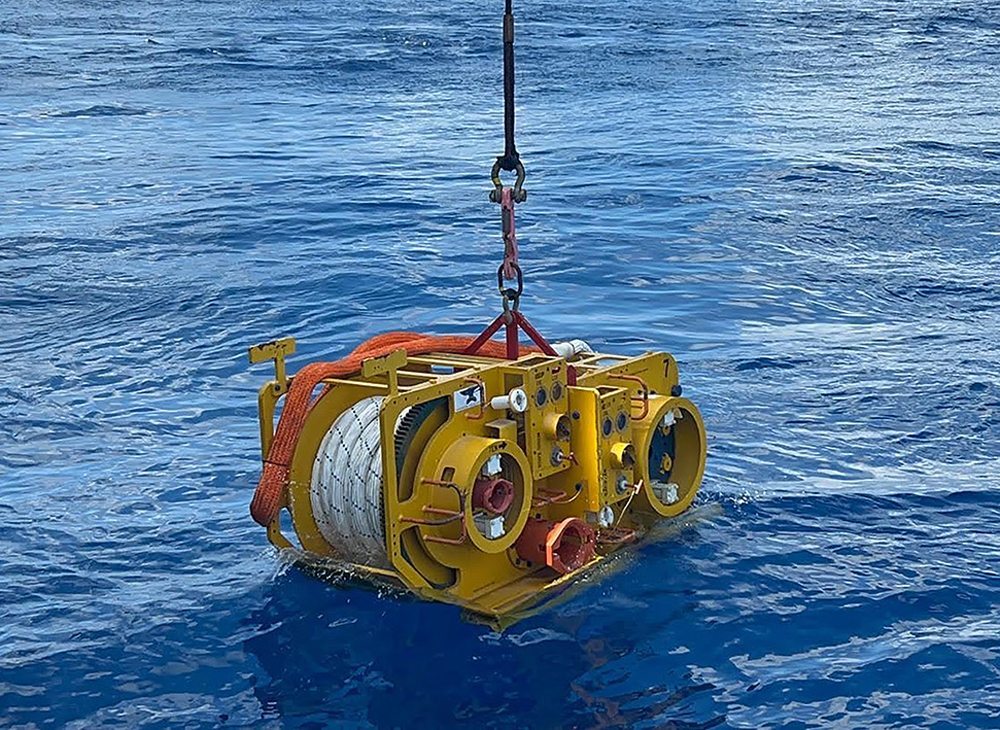
TBOP technology changes the parameters by introducing robustness into the riser, BOP and wellhead structural system, to prevent damage that could lead to the high consequences. This is accomplished by applying lateral resistance to the top of the BOP. During a loss-of-station-keeping event, this resistance counteracts the increasing lateral load applied by the riser and minimizes the deflection of the BOP and wellhead structure. It also mitigates the high consequences associated with toppling of the BOP. The riser lateral load is applied at the flex joint, located at the bottom of the riser, where it is connected to the BOP through the lower marine riser package. This lateral load is expressed as:
Lateral Load = Riser Effective Tension x sine (Lower Flex Joint Angle) + Added Shear Force
The added shear force is due to the beam properties of the riser and is accounted for in the riser analysis.
Another benefit of the TBOP—not related to loss of station-keeping—is that this solution mitigates cyclic loading, which can cause fatigue in the BOP and the wellhead structure.
TBOP ASSEMBLY
The TBOP provides added robustness through a system of synthetic ropes that introduces resistance to the lateral load applied by the riser at the top of the BOP during a loss of station-keeping event, Fig. 1.
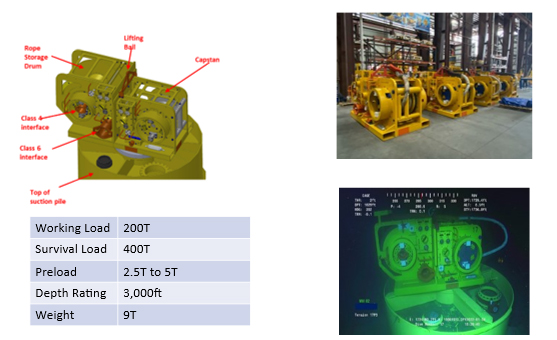
Specially designed high-capacity tensioners, equipped with synthetic ropes, are located on a rig, which are typically spaced equally, radially and equidistant from the well. An ROV attaches the synthetic ropes to connection points on the BOP, and the ropes are pretensioned, to ensure the system works effectively in a loss-of-station-keeping event. The synthetic ropes are sized, based on their stiffness, to assure that any deflection of the BOP is resisted, and the load is transferred into the suction pile foundations, Fig. 2.
Attaching the synthetic ropes to suction piles, rather than to an anchor system that could slip, is critical to proper functioning. The load-deflection curve of the synthetic ropes must match the resistance required for the desired behavior of the BOP and wellhead structure.
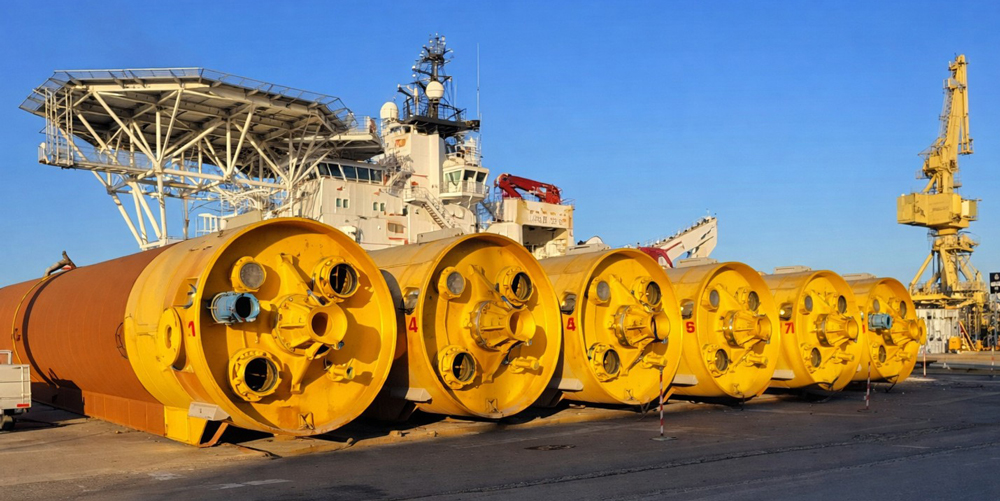
Geotechnical analysis is performed to determine the size of the suction piles required, as well as their arrangement and distance from the BOP. This allows appropriately designed suction piles to be embedded at the proper depth, to achieve the required lateral response from the main pile geometry, Fig. 3.
LOSS OF STATION SCENARIOS FOR ANALYSIS
During normal offshore drilling operations, a DP drilling vessel is stationed within a few feet of a set point location directly above the subsea BOP and wellhead to avoid wear at the lower flex joint, which connects the riser to the BOP. A standard loss of station—or drift-off—was analyzed, with and without the TBOP, to assess relative performance of the riser and BOP/wellhead configurations at various sites. This scenario was designed to simulate a complete loss of vessel power in a prescribed set of wind, wave and current conditions. Although total power loss rarely occurs under normal operations, these conditions were used as a basis for performance to demonstrate the benefits of the TBOP in an extreme scenario.
During a loss-of-station-keeping event, drilling is suspended, and preparations are made to disconnect the riser from the BOP stack, all while observing site-specific guidance for activating the EDS.
Typical riser and BOP/wellhead analysis is conducted using the drift-off scenario to determine when operability limits are reached. These are referred to as:
- Yellow alert offset (or circle), at which time preparatory actions begin
- Red alert offset (or circle), at which time the EDS should be activated, and
- Point of disconnect (POD), the offset and time at which the disconnect should occur.
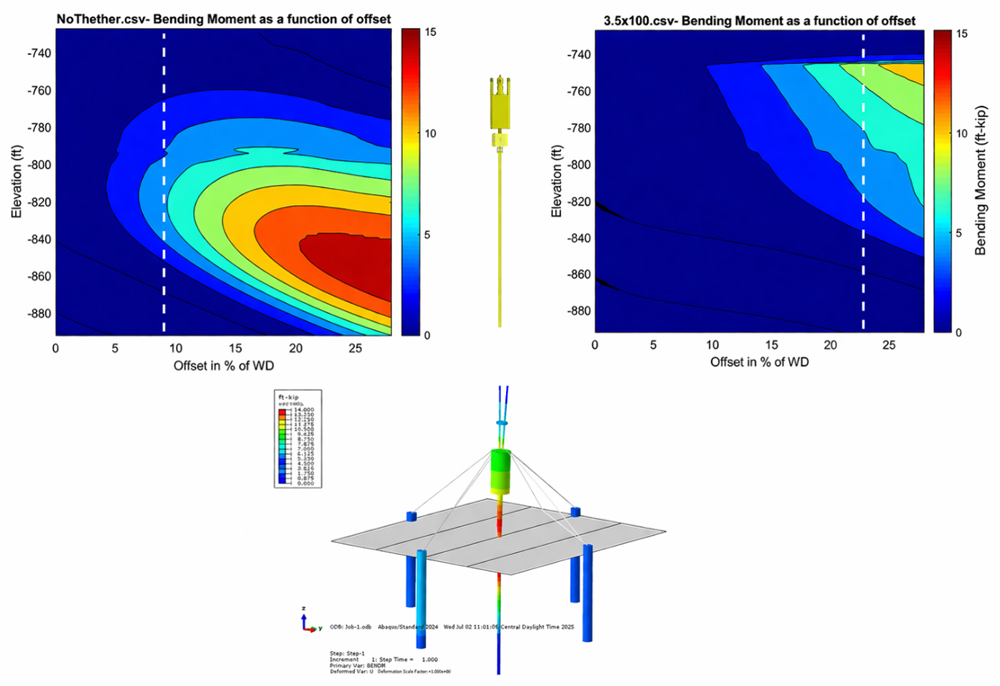
The effectiveness of the tethering system is illustrated in plots below, which show the comparison of bending moment profiles in the untethered and tethered load cases as the DP rig drifts off, Fig. 4.
The allowable operability limits in the system are both functional and structural, and in a typical configuration, they include the following:
- Lower flex joint angle (typically 10o, reduced by a safety factor)
- Upper flex joint angle (typically 10o, reduced by a safety factor, with consideration for moonpool clearance)
- Telescopic joint stroke (varies with stroke capacity and set point)
- Tensioner stroke (varies with stroke capacity and set point)
- Riser stress allowables (von Mises stress)
- Conductor stress (pipe allowable stress)
- Wellhead connector (sealability and structural ratings)
- BOP component capacities (sealability and structural ratings).
When a TBOP system is factored in, operability limits also include:
- Pile capacity
- Synthetic rope stiffness and capacity
- Tensioner capacity.
With a TBOP system, the BOP component loads, wellhead load and conductor stress are always maintained at low levels to protect the associated components from failure. The components above the BOP—for which failure is generally less consequential—are designed to fail first.
OPERABILITY ANALYSIS
API RP 16Q describes the method for conducting a drift-off analysis of a drilling riser and BOP/wellhead/conductor system. In some instances, shore-based riser analysis is used in combination with rig-based software.
Several physical effects are accounted for in this process:
- As the vessel loses station, the riser acts as a mooring line. This is due to the riser’s top tension being applied at an angle relative to vertical. The lateral force tends to resist the excursion of the vessel.
- As the vessel loses station, the transient response of the riser shape is impacted differently by high-speed and low-speed vessel excursions. This affects riser angles and riser stroke. Although the effect is more significant in deep water, it is also important in relatively shallow water.
The drift-off analysis should include sensitivity cases when the assumed input parameters, such as the following, have significant uncertainties:
- Seasonal weather—differences in metocean conditions in winter vs. spring
- Set point of the telescopic joint—uncertainty about where the joint will be set during operations
- Set point of the riser tensioners—uncertainty about tensioner settings during operations
- Mud weight—variations in top tension and mud weight during drilling operations
- Components—accuracy of properties, e.g., flex joint moment vs rotation for weak point analysis
- Soil properties—uncertainty at various locations for individual suction piles and at the wellhead.
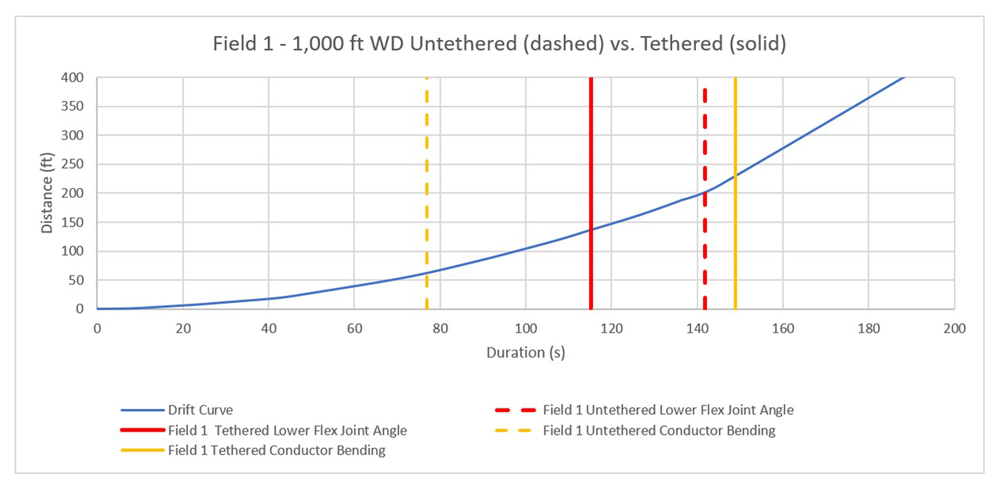
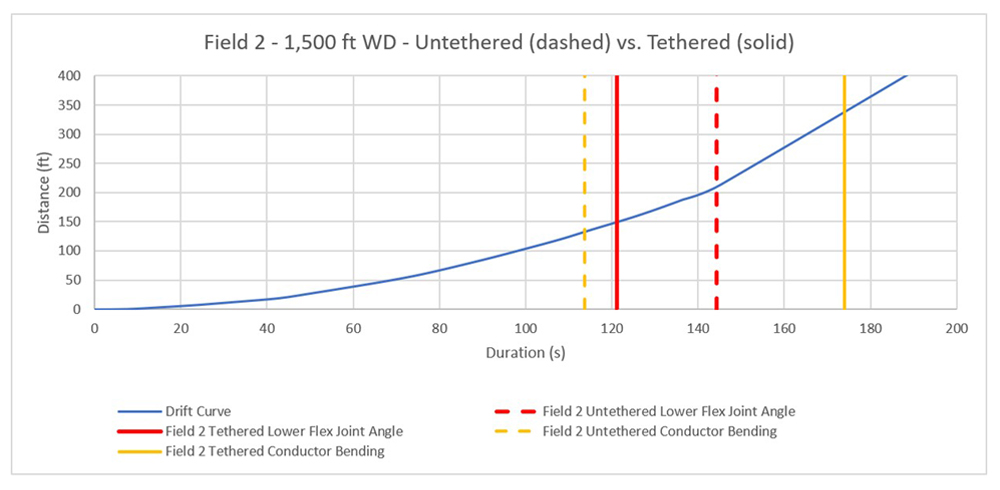
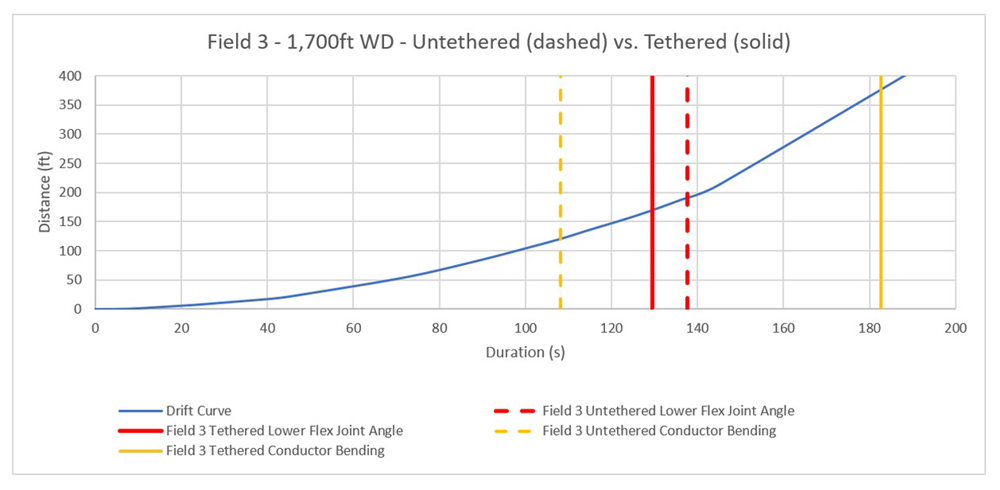
TVO conducted operability analyses of DP drilling operations on three GOM/GOA fields with water depths of 1,050 ft (320 m), 1,456 ft (444 m) and 1,736 ft (529 m). A drift-off scenario was used as the basis for an operability analysis for the three wellsites, to understand the behavior of the system and its components. Results for all three fields demonstrate the benefits of TBOP technology, Figs. 5-7.
WEAK POINT ANALYSIS
Weak point analysis is an extension of operability analysis, and it identifies the vulnerable components in the system, taking into account water depth, mud weight, soil properties, the drift-off scenario experienced, and the TBOP design. In general, weak point analysis identifies both functional failure (including sealability) and structural failure. The same drift-off scenario used for operability analysis is simulated, and the analysis progresses until the components fail completely.
This analysis requires understanding of the behavior of components beyond their allowable limits and material yield to failure. Identifying the weak points enables better understanding of the consequences of the scenario, and it provides the knowledge necessary to modify the system design to drive an ultimate failure to a preferred component or subsystem.
Although failure of any of the riser components located above the BOP has consequences, those consequences generally are associated with asset loss and NPT. On the other hand, failure of the BOP components, wellhead and casing strings can have additional consequences, including loss of well containment. In the case of the riser and BOP/wellhead, weak point analysis results can be used in the system design such that the first failure occurs in the riser components rather than in the BOP/wellhead structure.
TBOP PERFORMANCE
The technology was put to the test in three fields in the GOM/GOA, with water depths ranging from 1,700 to 2,200 ft (518 m to 670 m). Field 1 wells were producing gas, Field 2 wells were producing oil and gas, and Field 3 wells were producing gas and condensate.
As applied to these three fields, the components of the tethering system were connected to the top of the BOP of an ultra-deepwater DP drillship rated for a 12,000-ft (3,660-m) water depth. Installing the TBOP system allowed the DP drillship to operate safely, with daily checks on the load cells on the BOP yoke, to ensure loads were in an acceptable range. Should the load have measured outside that range, the tensioners could have been reset to the proper load, using an ROV.
EXTENDING THE REACH OF TBOP TECHNOLOGY
The problem resolved by this proprietary tethering system is not confined to the GOM/GOA. Rig availability continues to drive shallow-water operators around the world to consider DP units, and many companies are looking for ways to drill wells safely and economically in these areas. This is an engineering challenge for the entire industry.
The successful installation of a TBOP on a deepwater drillship demonstrates that this technology can enable a DP rig designed for deepwater applications to drill safely in shallow water, and it introduces a way to explore shallow-water prospects around the world, using deepwater DP rigs.
KIM MITTENDORF (kim.mittendorf@vulcanoffshore.com) is engineering manager at Trendsetter Vulcan Offshore in Houston. Before joining TVO, he served as director of projects and as a senior researcher at Horton Wison Deepwater Inc. He also filled the role of chief functional engineer at Gamesa Wind US. Mr. Mittendorf holds Dr.-Ing. and Dipl.-Ing. degrees in civil engineering from Leibniz University in Hannover, Germany, and he is a member of the Project Management Institute and ASCE.
KEVIN CHELL (Kevin.Chell@vulcanoffshore.com) is vice president at Trendsetter Vulcan Offshore in Houston, where he leads TVO’s TBOP business, managing both business development and projects. He has served in leadership positions in multiple organizations in the global upstream oil and gas sector. He holds a bachelor’s degree in civil engineering from Imperial College, London, and an MBA from Cranfield University in Cranfield, England.
JAMES N. BREKKE (james.n.brekke@gmail.com) is owner and president of Brekke Offshore Consulting, LLC. He previously served as director of offshore performance at ABS and director of marine support at Transocean. He holds a bachelor’s degree in applied math, engineering and physics, and a master’s degree in engineering mechanics from the University of Wisconsin in Madison. He is a SNAME Fellow and life member of SNAME and ASME.
Related Articles- Late-life field management: Repair, repurposing and obsolescence management support sustainable well integrity (June)
- Enhancing Lower Tertiary recovery and profitability: The options – Part 2 (May)
- Nova Scotia’s Premier aims to revive province’s oil and gas activity (May)
- First Oil: OTC soldiers on for another year (May)
- OTC recognizes 2026 Spotlight on New Technology® Award winners (April)
- A deep understanding of flow patterns and pressure fields (April)
- Subsea technology- Corrosion monitoring: From failure to success (February 2024)
- Applying ultra-deep LWD resistivity technology successfully in a SAGD operation (May 2019)
- Adoption of wireless intelligent completions advances (May 2019)
- Majors double down as takeaway crunch eases (April 2019)
- What’s new in well logging and formation evaluation (April 2019)
- Qualification of a 20,000-psi subsea BOP: A collaborative approach (February 2019)