Refracturing immediately increases gas rate 700% and sustains 400% increase for three months in Haynesville shale well
Facing challenges: understimulation and high drawdown
Comstock Resources wanted to optimize production of its gas wells in the Haynesville shale. To do so, Comstock needed to address two major factors that contribute to the underperformance of horizontal natural gas wells in the Haynesville: understimulation of the lateral and high bottomhole pressure drawdown. High drawdown pressures degrade both fracture extent and conductivity, substantially reducing production potential. Comstock opted to use refracturing as a low-cost means to reinvigorate existing fracture networks in damaged wells and initiate new fractures in undepleted rock.
Refracturing in challenging conditions
Effective refracturing operations can significantly improve production from previously depleted laterals. Many wells are potential refracturing candidates, including wells with small fracturing volumes, large stage spacing, high drawdown or skin values, or wells fractured many years ago with outdated technology. The combination of existing perforations and a depleted reservoir greatly alters the in situ stress, which makes it challenging to develop a plan that accounts for the well’s unique conditions. However, even under some of the most difficult conditions, refracturing is still able to improve well economics and overall production.
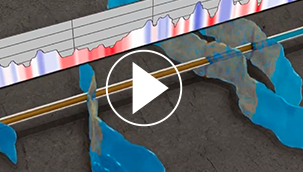
Watch video on developing strategies for refracturing operations in North America.
Restoring fracture connectivity
Comstock selected the PACE 33 HZ #1 as the first of its wells in the Haynesville shale to be refractured. Thorough candidate analysis suggested it had likely experienced high drawdown coupled with low proppant volumes during the initial completion. Schlumberger recommended using BroadBand Sequence fracturing service to enable effective refracturing through an engineered application of a crosslinked fluid coupled with a proprietary, fully degradable chemical diversion plug made up of a blend of particles and fibers. For the refracturing treatment, fracturing fluid and proppant were diverted along the horizontal extent of the wellbore without the need for mechanical isolation by using Broadband Sequence service chemical diversion techniques. Degradable fibers in both the fracturing fluid and composite diversion pill were used to improve proppant transport along the lateral to create new fractures, reconnect existing fracture networks, and enhance the stimulated reservoir volume.
Ensuring every cluster delivers its full potential
BroadBand Sequence service was used to sequentially isolate, fracture, and stimulate each zone, resulting in more reservoir volume and greater contact. The composite fluids were diverted to higher stress regions for increased fracture stimulation within each stage before degrading to restore full fracture conductivity. By sequentially isolating fractures, the BroadBand Sequence service ensured every cluster in each zone was fractured and could contribute to the well's full potential. This maximized well productivity and improved completion efficiency while significantly reducing completion hardware and overall completion costs.
Increasing immediate and short-term production
Using BroadBand Sequence service to perform refracturing improved both immediate and short-term production of the natural gas well. Immediately following the refracturing operation, production surged to 4,000 Mcf/d from 500 Mcf/d—a 700% increase—while flowing pressure increased 300%. In the first three months after refracturing, the well sustained a production increase from 500 Mcf/d to 2,500 Mcf/d—a 400% increase.