Devon Energy’s Gaspar sees good things ahead, stemming from his first year and the imminent merger with Coterra Energy
(WO) - During the third day of CERAWeek by S&P Global 2026, Devon Energy President & CEO Clay Gaspar engaged in a wide-ranging conversation with Raoul LeBlanc, Vice President for Upstream at S&P Global. They touched on his first year in his current position, his operating philosophy, the impact of the recently announced merger with Coterra Energy, and the potential impact of AI.
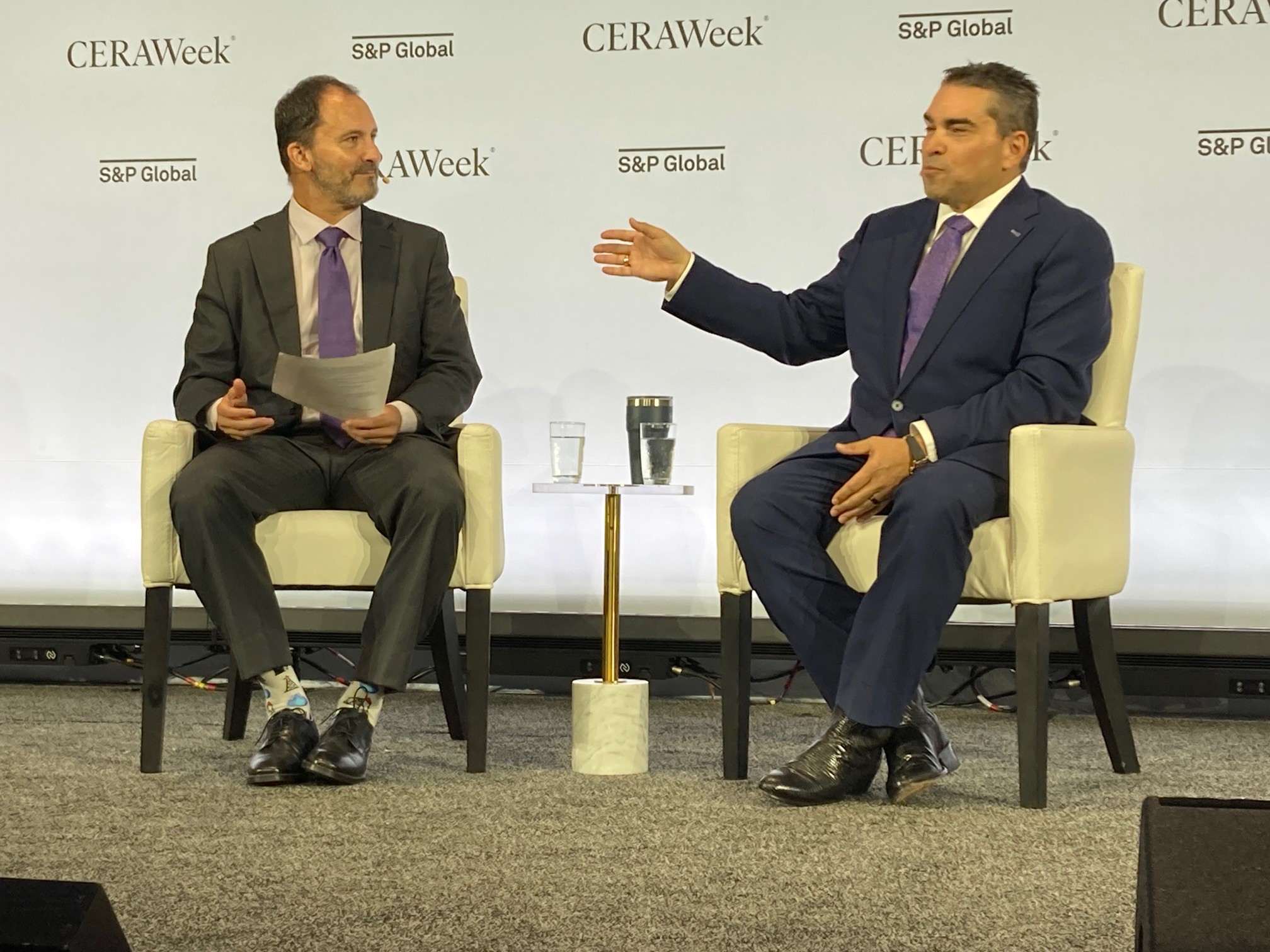
LeBlanc started off by reminding Gaspar that he had been made CEO of Devon about a year ago and how it felt to take the helm. He also asked Gaspar how his view of Devon might be different looking through the eyes of a CEO, as compared to his previous experience. “You know, I was excited at the time,” mused Gaspar. “It was something that I anticipated, as my mentor and dear friend, Rick Moncrief, and I worked very closely for a number of years, both at WPX and then at Devon. And so, I created a proximity to the role. And like I said, I had incredible mentors along the way, which you don't really know until you know until you're on the scene. Immediately out of the gate, the first order of business was what do we do to capture this moment in time? Because, in the 50-plus year history of Devon, we've only had five CEOs. So, how do we make sure that we rally the troops, we organize, we focus? We're really clear about this strategy. These are the things that we're going to inflect in the culture, in the strategy, and this is the mountain that we’re going to take. And that really led to the business optimization program that we've [conducted during] the last year.
The challenge at hand. LeBlanc then asked Gaspar how he sees the challenge for Devon and how that differs from the past 10 years. “There's a saying that the more challenging questions continue to work uphill,” offered the CEO. “I would say the team, we all had great relationships. I knew the team members. A couple of folks I had elevated internally. One person I hired from the outside had an existing relationship. But I think that kind of mixing things up really helped that inflection. Without question, getting that team on was one of the easier times. When we're thinking aspirationally, these are board-level considerations. I had to reintroduce myself, so to speak, to the board, who I knew well, but they knew me in a different capacity. Getting realigned with the board when you're talking strategy, when you are talking long-term vision was a real consideration. So, making sure that we don't run ahead or behind in that board relationship was critical.
“And then,” continued Gaspar, “absolutely important is getting the organization to really understand and buy into the vision. So, we set out a three-pillar strategy. Pillar one was make Devon a better Devon. Pillar two was thinking long-term about some organic opportunities that we had to create value, leverage the skills we had, and then certainly pillar three is how do we improve the portfolio that we have and all that stuff that we're typically doing in the background all the time.
The Coterra merger. From that philosophical angle, LeBlanc asked Gaspar what his first year as CEO has led to now. “To this big merger [with Coterra Energy],” answered Gaspar succinctly. “Yeah, it certainly wasn't an intention to merge at the end of that year. Our singular focus—which we're very transparent with the board, the team, the organization, the investors—was we've got a lot of self-help to do. There are opportunities for us to grab another gear in all facets of what we've done. And so, really focusing on sustainable, free cash flow was something that we thought was an all-inclusive goal.
“Top line,” continued Gaspar, “how do we improve production? How do we minimize downtime, how do we improve recovery factors, the cost structure, how do we lower lease operating expense, how do we lower G&A costs, and then third, very important for our type of organization, is thinking about the capital cost. When we looked at 2025, with a preliminary guide in November, we thought it was going to be $4.1 billion to keep our oil production flat with maintenance capital. When we look back today at 2025, we were actually able to achieve a little bit of oil growth for just under $3.6 billion in a non-deflationary environment.
Pressing further on the Coterra deal announced early in 2026, LeBlanc asked Gaspar that if he wasn’t necessarily planning on an acquisition as a solution to a problem, was this merger about offense, defense or inevitability? “Let's be real,” responded Gaspar. “Devin and Coterra are not strangers. Two of three of Coterra’s basins we overlap. It’s a great asset fit. Our teams have a tremendous amount of mutual respect, work very well together, we're in each other's wells, and we sit on industry boards together.
“So, when the opportunity presented itself, we were both pretty familiar. Obviously, we're exceptionally well-covered. With E&P companies, there's not a lot of secrets. We talk to our investors continuously, as does the Coterra team. And it was a pretty easy kind of comparison to say, how would this work? The industrial logic was through the roof. You’ve got two strong operational teams, and when you combine them effectively, it raises the collective bar together. That's when the magic happens in these kinds of combinations.”
Next phase after achieving scale. This caused LeBlanc to remark, “And so I wonder, now that you’ve achieved scale [through the merger], what's the next act? How are you going to drive value?”
“There are [several] things I've learned over the last year, and maybe it's relearned or re-acknowledged, because these are intuitive,” reflected Gaspar. “The first is never underestimate a high-quality team when they are focused, when they have accurate direction, and that's what we learned over the past year. Now, post-combination, we hope to close the second quarter. We're going to refocus, and we're going to have a new goal. We're going to have a billion-dollar synergy target….The second [lesson] is the AI revolution is real, and I know this, I love it, I live it, but really watching the team not just unleashed, but empowered by AI in all facets. I mentioned the D&C team. They’re the team that has the most data; they have a report card every single day on progress. They're set up for this kind of win.”
Cutting the fat. LeBlanc asked Gaspar how one goes about cutting the fat after a merger without cutting into the bone. “I think in many instances, if G&A is the expense, think of a consulting business,” explained Gaspar. “You've got revenue, you've got all your people, and you have profit. Yeah, that's not us. For every dollar that we bring in, we spend about three cents, that we're going to increase by half a penny. But that half a penny creates value like that half a billion dollars on reducing capital. I would take that bet every single day.
“The fat will come out of the inefficiencies of the system,” continued Gaspar. There's always an inefficiency of the systems. But objectively, there will be jobs that are duplicative. One of my favorite sayings, I don't know who coined it, but I'll repeat it, ‘there's still too many CEOs per barrel.’ But we're just at a maturing part of our business and so that comes with these combinations to get done well. A combination done well really can create not just scale, but a higher-quality company, which I'm much more excited about than just the scale itself.
Phasing in AI usage. Winding down the conversation, LeBlanc asked Gaspar what he thought Devon could use more of, to improve function and results. “Of use for us is AI—how do we access data quicker,” responded Gaspar. “We've done a really phenomenal job of standing up a very secure system and a very connected system to our data. Our employee base has very good connectivity to instantaneous data. That's wave one. Wave two is where you take this existing process and you think of a 10 person team that's working these really, really complicated problems and you take the parts that are challenging from a grinding standpoint or from a just some time standpoint, maybe they can have AI take that role and speed the whole team up. That's wave two. Wave three, and I'm telling you we're moving in this direction, is taking AI teams' focus and capability with AI at the center, and then we put humans around that to support it.”