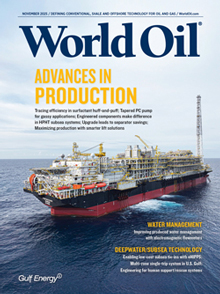
Issue: November 2025
FEATURES
The oil and gas industry is increasingly adopting electromagnetic flowmeters (magmeters) to improve produced water management. With superior accuracy, reliability and smarter diagnostics than mechanical meters, magmeters help operators handle rising water volumes and regulatory demands, supporting more efficient and sustainable oilfield operations.
In the future, the need for reliable, compact, and compliant human support systems will only grow. As offshore industries transition into deeper waters and begin to intersect with emerging sectors, the importance of safety-focused engineering becomes even more paramount.
Eavor Technologies Inc.’s Geretsried project in Bavaria, Germany, is the first commercial deployment of its closed-loop (Eavor-LoopTM) advanced geothermal system. This article outlines the technical achievements in multilateral drilling performance, including a 90% improvement in rate of penetration, 3x increase in bit run lengths, and the integration of enabling technologies, such as insulated drill pipe and active magnetic ranging.
A modular containment system helps operators maintain production during return-to-pad drilling campaigns.
COLUMNS
In his newest column, World Oil editor-in-chief Kurt Abraham breaks down the Trump administration’s sweeping new offshore leasing strategy—an overhaul that replaces the restrictive Biden-era plan with a far more expansive five-year program.
(WO) - New Mexico’s push for a sustainable produced water program has devolved into political gridlock. In this month’s column, Mark Patton unpacks how a once-promising plan collapsed into regulatory drama—while Texas charges ahead with pilot projects that could redefine water reuse across the Permian.
As LNG export capacity surges and AI-driven power demand skyrockets, U.S. natural gas is poised for its biggest growth cycle yet. In this month’s Drilling Advances, columnist Ford Brett breaks down why “trash gas” may soon turn to gold—and what a 25% jump in gas production by 2030 means for rigs, crews and drilling technology.
World Oil contributing editor Bill Head argues it’s time to “unleash” Alaska once again—reviving cost-share research, accelerating exploration and embracing new subsurface technologies. From Permanent Fund history to modern imaging advances, this column examines why frontier basins may be poised for a resurgence.
SPECIAL FOCUS: ADVANCES IN PRODUCTION
Operators are under mounting pressure to keep subsea equipment reliable in HPHT environments. Pumps, valves and control systems depend on seals, insulators and connectors designed to endure extremes where traditional materials fail. Advances in thermoplastics and harness assemblies are proving that the smallest parts can redefine offshore reliability.
The replacement of a problematic pneumatic level controller and valve resulted in significant uptime and throughput savings for a Canadian upstream producer.
NOV discusses how real-time, digital ESP management solutions help unlock new levels of efficiency across a well’s production life cycle.
How field trials provide new insights into fluid movement, recovery and EOR performance.
WEATHERFORD SPECIAL SUPPLEMENT, Part II